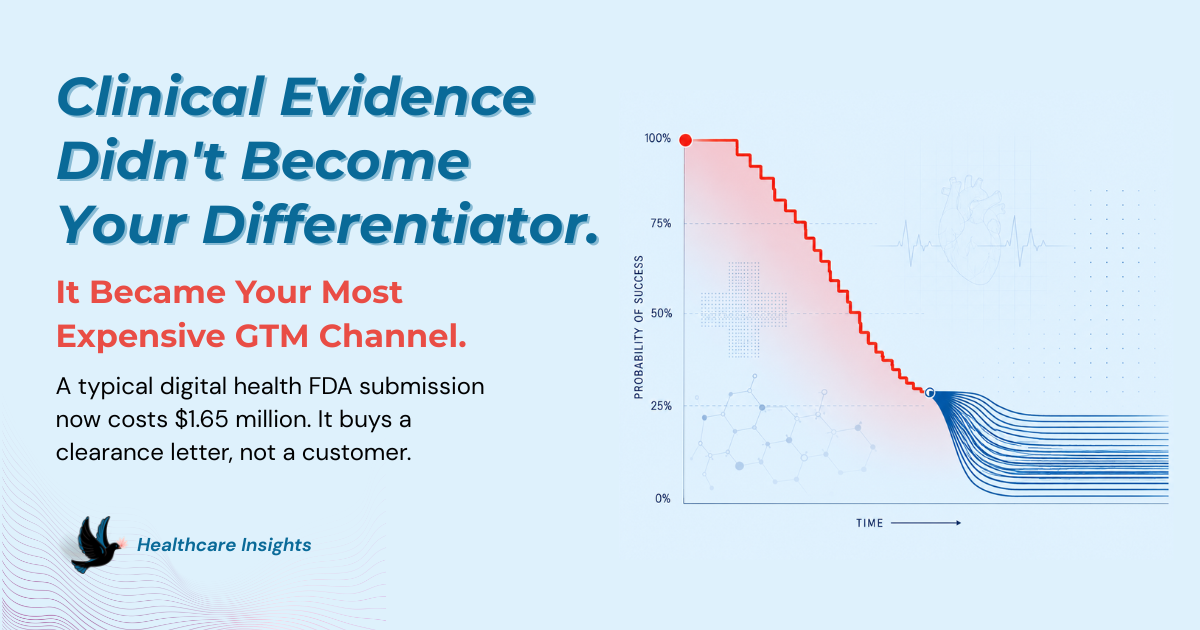
FDA clearance used to be the thing that separated a serious digital health company from a wellness app with better marketing. Founders raised on that story still build their entire go-to-market plan around getting cleared first and selling second. What they’re actually buying is a $1.65 million to $100 million line item that increasingly has nothing to do with whether anyone pays for the product once it’s cleared.
Summary
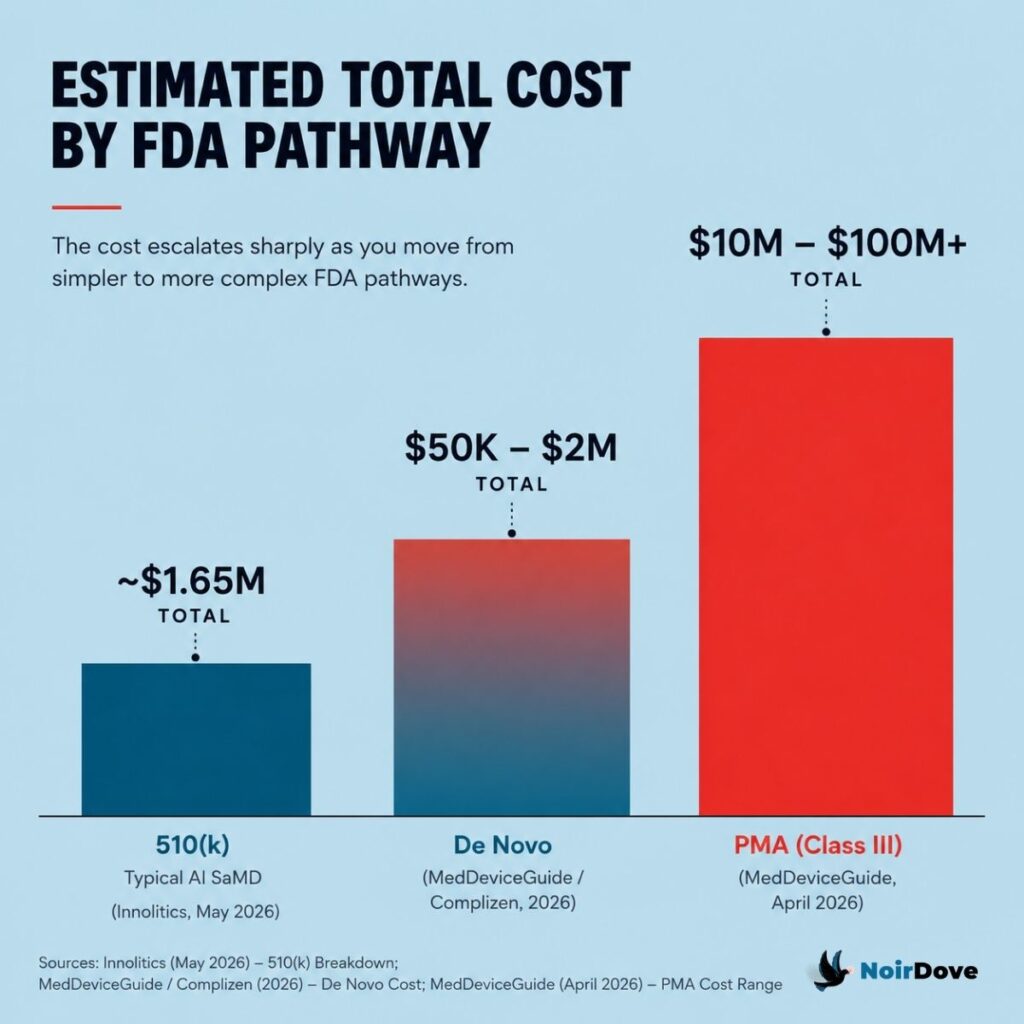
- A 510(k) submission for a typical AI-enabled digital health device now runs approximately $1.65 million end to end, per a May 2026 cost breakdown from regulatory consultancy Innolitics, with clinical and performance validation alone accounting for $400,000 to $700,000 of that.
- A Class III PMA pathway, the route required for higher-risk devices, runs $10 million to over $100 million, with clinical trials consuming the largest share of that cost.
- Pear Therapeutics held three FDA clearances, including the first De Novo clearance ever granted to a digital therapeutic, and more than 40 supporting studies. It filed for Chapter 11 bankruptcy in April 2023, unable to secure insurer reimbursement.
- Hinge Health and Omada Health, which sell directly to self-insured employers rather than building their GTM plan around insurance reimbursement of an FDA-cleared claim, generated $432 million and $170 million in revenue respectively in the twelve months before their 2025 IPOs.
TLDR
FDA clearance is not the moat founders think it is. A typical digital health 510(k) now costs around $1.65 million, and a PMA pathway can run past $100 million, most of it clinical and regulatory documentation, not product. Pear Therapeutics proved clearance alone doesn’t guarantee reimbursement or revenue: three FDA clearances, 40-plus studies, and still bankrupt in 2023. Hinge Health and Omada Health proved the opposite is possible: sell directly to employers, prove adoption and outcomes at commercial scale first, and let clinical evidence follow the revenue instead of gating it. The sequencing decision, not the rigor of the evidence, is what determines whether a healthtech company survives long enough to use its clearance.
FDA Clearance Looks Like a GTM Advantage. It Behaves Like a GTM Anchor.
Every digital health founder pitching investors in 2026 has heard some version of the same advice: get FDA clearance early, because it signals credibility, opens hospital and payer conversations, and keeps competitors out. The advice isn’t wrong about what clearance signals. It’s wrong about what clearance costs, and what it doesn’t guarantee.
Innolitics, a regulatory consultancy that publishes detailed FDA submission cost breakdowns, priced a traditional 510(k) for a typical AI/ML software-as-a-medical-device product at roughly $1.65 million as of its May 2026 analysis. The FDA’s own user fee is a rounding error inside that number, around $26,000 for a standard FY2026 510(k) submission. The real cost sits in regulatory strategy and submission authoring, $250,000 to $400,000, and in clinical and performance validation, $400,000 to $700,000, the single largest line item for most AI-enabled devices. For anything requiring a De Novo pathway or full Premarket Approval, the numbers climb fast. A Class III PMA, the pathway required for higher-risk devices, runs $10 million to over $100 million from concept to approval, with clinical trials accounting for the largest share of that spend, according to a 2026 budget analysis from MedDeviceGuide.
None of that is optional once a founder has committed to the pathway. And none of it happens fast. FDA’s own target timelines are 90 days for a 510(k) and 180 days for a PMA after submission, but founders should budget 6 to 12 months of preparation before that clock even starts. A founder who commits to FDA-first as the GTM strategy is committing 18 to 36 months and seven figures of capital to a process that ends with a clearance letter, not a customer.
Why Founders Still Chase Clearance First, Even Though the Math Changed
The FDA-first instinct made more sense a decade ago than it does now. In 2017, Pear Therapeutics became the first company to secure a De Novo clearance for a digital therapeutic, reSET, aimed at substance use disorder. At the time, that was genuinely novel. It created regulatory clarity for an entire category and signaled to investors that software could be regulated, reimbursed, and prescribed like a drug. Pear went public via SPAC in 2021 at a $1.6 billion valuation, eventually holding three FDA clearances and backing them with more than 40 studies, several of them large-scale randomized controlled trials in peer-reviewed journals.
Pear filed for Chapter 11 bankruptcy in April 2023. The evidence wasn’t the problem. Insurers were. Pear’s CEO said publicly that payers could and did deny payment for its products even after the company demonstrated clinical effectiveness, necessity, and cost-effectiveness. Its products were priced above $1,000 and covered mainly by Medicaid, a narrow reimbursement base that never scaled into the broader commercial insurance market Pear needed. Akili Interactive followed a similar arc: FDA clearance for its attention-disorder treatment EndeavorRx, poor prescription sales, a pivot to an over-the-counter model in 2023, and an asset sale in 2024.
By December 2024, the FDA had cleared 192 software-as-a-medical-device products, per a review published in npj Digital Medicine. Clearance stopped being the differentiator it was in 2017 and became the entry price for a category everyone now knows how to pursue. What hasn’t changed at the same pace is the reimbursement landscape on the other side of that clearance, which is still decided company by company, payer by payer, in negotiations that have nothing to do with how rigorous the underlying clinical trial was. Founders pursuing FDA-first today are optimizing for a signal that stopped being scarce years before the check clears.
The GTM Budget Is Hiding Inside the Clinical Budget
Call the clinical validation line item what it actually is. For a company selling into hospitals, payers, or clinicians who require evidence before they’ll consider a purchase, clinical validation isn’t R&D spend that happens to precede commercialization. It’s the first and most expensive GTM asset the company builds, because it’s the artifact that unlocks every subsequent sales conversation.
Run the Innolitics numbers again with that lens. Clinical and performance validation, $400,000 to $700,000, is 24% to 42% of the full $1.65 million 510(k) budget for a typical AI SaMD product. On a PMA pathway, where clinical trials are explicitly described as the largest cost component of a $10 million to $100 million total spend, that share climbs well past that. A founder who has raised a $5 million or $8 million seed round and is putting a third to a half of it into a study designed to satisfy a regulator, not a customer, has functionally reallocated their marketing and sales budget into a single, slow-moving asset with a binary outcome. If the trial reads well and the clearance comes through, they’ve spent a GTM budget’s worth of capital on one channel. If it doesn’t, they have nothing to show a customer at all.
Founders rarely categorize it this way when they’re building the budget. It gets filed under “product development” or “regulatory,” a cost center, not a growth line item, which is exactly why the GTM debt doesn’t show up until the company is trying to scale and discovers the clinical asset it spent two years and millions of dollars building doesn’t move a payer’s reimbursement decision the way the pitch deck assumed it would.
Prove Adoption First. Let the Evidence Follow the Revenue.
Hinge Health and Omada Health didn’t skip evidence. They sequenced it differently, and the sequencing is the entire lesson.
Hinge Health does hold an FDA clearance, on Enso, a wearable device used inside its musculoskeletal care program. But Enso’s clearance was never the gate its GTM plan waited behind. Hinge sold directly to self-insured employers, the buyer who controls the budget and doesn’t require FDA clearance or insurance reimbursement approval to sign a contract for a care program that demonstrably reduces MSK-related claims costs. By the twelve months ending March 2025, Hinge had booked $432 million in revenue, 80%-plus gross margins, and client relationships with roughly half of the Fortune 100, ahead of a May 2025 IPO that raised $437 million.
Omada Health ran the same play in chronic disease management. It sells to employers directly or through health plan and PBM channel partners, not through an insurance reimbursement pathway gated by a specific FDA claim. Revenue grew from $123 million in 2023 to $170 million in 2024, accelerating to $55 million in a single quarter by early 2025, ahead of its own June 2025 Nasdaq debut. Neither company waited for a regulatory clearance to prove that employers would pay for outcomes. They proved the market would pay first, with the evidence base they had, and built additional clinical rigor on top of an already-funded, already-scaling business.
The founders who get this sequence wrong don’t fail because their clinical evidence is weak. Pear Therapeutics had some of the strongest evidence in the industry and still ran out of runway. They fail because they let a regulatory pathway designed to satisfy a government agency stand in as their entire commercial validation strategy, when the actual buyer, whether that’s an employer, a health plan, or a hospital system, was asking a completely different question the whole time: not “is this cleared,” but “will this get adopted, and will it save or make me money.”
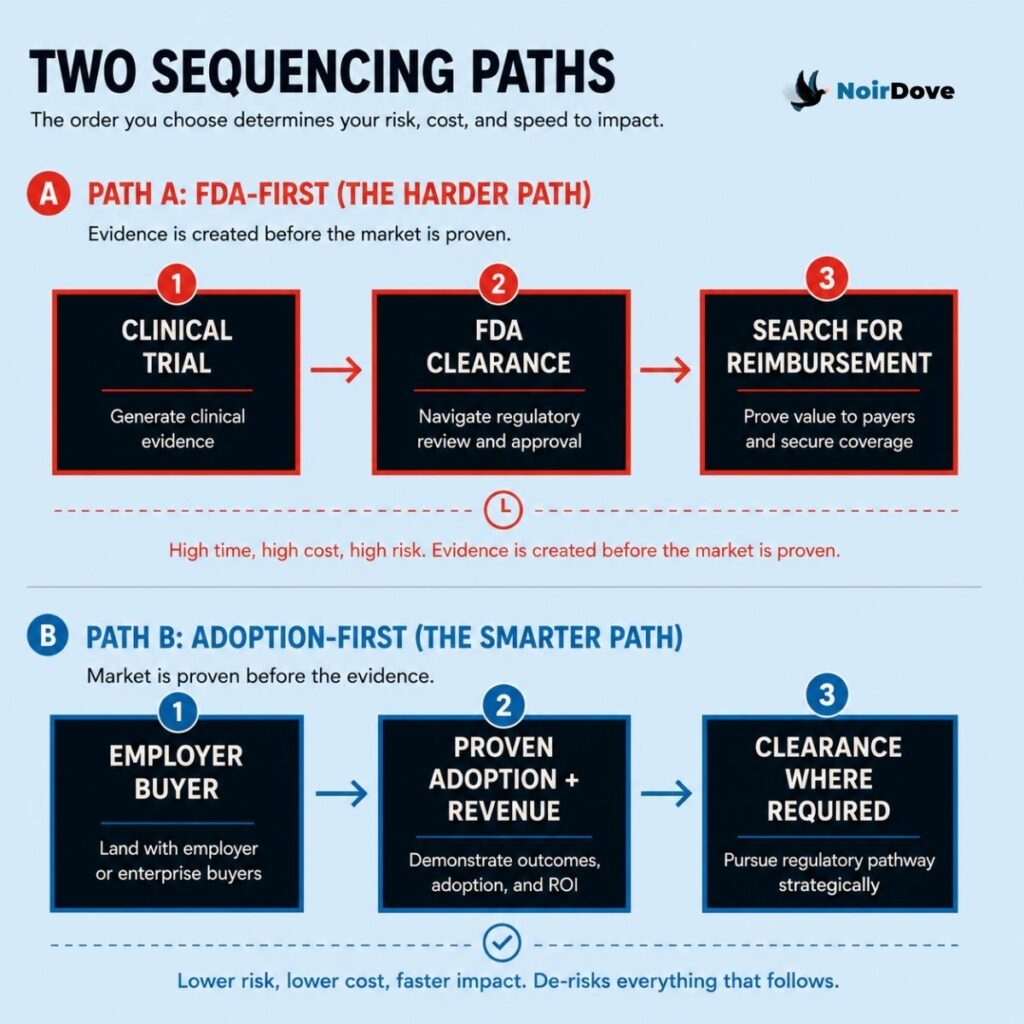
The framework that survives this is simple to state and hard to execute under investor pressure to show a regulatory milestone. Find the buyer who can say yes without waiting for a payer or a regulator, usually a self-insured employer or a cash-pay channel. Prove adoption and outcomes at a commercial scale with the smallest evidence base that buyer actually requires. Only then invest the seven-to-eight-figure sum a full FDA pathway costs, once there’s a revenue base to justify the timeline and a specific reimbursement conversation the clearance is actually meant to unlock. Reverse that order, chase the clearance while the commercial model is still a hypothesis, and the FDA process stops being validation. It becomes the thing that ran out the scaling window before the company ever got the chance to use it.
FAQs
Does this mean founders should avoid FDA clearance entirely? No. It means the clearance should follow proof that a buyer will pay, not precede it. Companies selling into hospital systems or pursuing pharmacy-benefit-style reimbursement often do need clearance eventually, sometimes early, because that specific buyer requires it. The mistake is treating clearance as a universal first step regardless of which buyer the company is actually trying to reach.
Why did Pear Therapeutics fail if its clinical evidence was genuinely strong? Because clinical evidence and reimbursement approval are decided by different parties on different criteria. Pear’s CEO said publicly that payers denied coverage even where effectiveness, necessity, and cost-effectiveness had been demonstrated. Insurers weigh cost impact, existing benefit design, and competing priorities, not just trial data. A strong study de-risks the clinical question. It doesn’t automatically answer the commercial one.
Is the $1.65 million 510(k) figure typical for all digital health products, or just AI-enabled ones? That figure, from Innolitics’ May 2026 analysis, applies specifically to a typical AI/ML software-as-a-medical-device product, where FDA’s additional expectations for training data, performance metrics, and generalization analysis add cost on top of a standard submission. A simpler, non-AI device with existing biocompatibility data can clear for as little as $50,000 to $75,000. The number a founder should budget against depends entirely on device classification and novelty, not a single industry average.
How should a founder decide whether their buyer requires FDA clearance before purchase, or not? Ask who signs the contract and what they’re buying. A self-insured employer purchasing a care program, the way Hinge Health and Omada Health sell, is buying an outcome and controls its own budget, which means it can say yes without a regulatory clearance in hand. A hospital system or a payer evaluating a product for formulary or reimbursement inclusion is a different buyer with a different requirement, and for that buyer, clearance may be a precondition, not a nice-to-have. The GTM plan should be built around the actual buyer’s requirement, not a generic assumption about what “credibility” requires.
Sources Referenced
- Innolitics, “How much will an FDA clearance cost?”, May 2026
- MedDeviceGuide, “PMA Submission Cost: Complete 2026 Budget Breakdown for Class III Devices,” April 2026
- FDA, Medical Device User Fee Amendments (MDUFA) Fee Schedule, FY2026
- STAT News, “Digital health pioneer Pear Therapeutics files for bankruptcy,” April 2023
- Managed Healthcare Executive, “What Does Pear Therapeutics’ Bankruptcy Mean for PDTs?”
- Healthcare Brew, “New year, new digital therapeutics pilot,” January 2026 (192 FDA-cleared SaMD products as of December 2024, per npj Digital Medicine)
- Fierce Healthcare, “HLTH25: Hinge Health and Omada broke the digital health IPO dry spell,” October 2025
- Galen Growth, “Digital Health Exits: Navigating 2025’s Shifting Tides Towards Maturity,” August 2025
- Sacra, Hinge Health revenue and IPO data, May 2026
Talk to Noir Dove
If your GTM plan has a regulatory clearance sitting where a commercial validation strategy should be, the sequencing is the problem, not the science. Noir Dove diagnoses where your commercial system breaks before the clearance timeline runs out of your scaling window. Book a Clarity Call. One conversation, before the next funding round gets priced against a milestone that doesn’t move a payer’s decision.