
Revenue Operating Model
Marketing, Sales, and RevOps Are Making Their Own Revenue Decisions Right Now.
For deep tech founders at $1M to $20M ARR whose revenue sits across Marketing, Sales, RevOps, and Leadership, not with one person.
Past $1M ARR, revenue rarely sits with one person. Marketing owns demand, Sales owns opportunities, RevOps owns the CRM, and Leadership owns the number everyone is chasing. Revenue Operating Model is one of our execution solutions, alongside Marketing, Sales, Product, and Revenue Intelligence. We scope it once a Deep Clarity Assessment finds the constraint is how functions are defined and connected, not positioning or data.
Marketing, Sales, and RevOps Each Have a Number. The Numbers Don't Agree.
The trouble starts when every function runs its own definition of the customer, the buyer, a qualified lead, a real opportunity, or a healthy pipeline. Marketing reports lead volume. Sales questions lead quality. RevOps reports pipeline stages. Leadership tries to work out which of those numbers describes what’s actually happening.
Noir Dove brings the commercial decisions behind those reports into one operating model, so every function works from the same definitions, the same priorities, and the same ownership.
"The result is a revenue model that Sales, Marketing, Leadership, and RevOps can actually run."

A Strategy Memo Doesn't Tell Sales Who to Call Monday Morning.
A revenue strategy can name the right market and the right positioning. A revenue team still needs clear answers to the questions that decide what happens next.
Noir Dove defines the answers, then connects them across the revenue process.
- Which companies should Sales pursue?
- Which buyers should Marketing attract?
- What makes an account qualified?
- What makes a lead worth Sales attention?
- When does a lead become an opportunity?
- Who owns the next action?
- Which pipeline numbers should Leadership trust?
- Which revenue initiatives deserve investment?
- Which problems need intervention now?
What Actually Has to be Defined Before Any of This Works
01 · ICP & Buyer Definition
Stop Sales and Marketing From Chasing Different Customers.
Sales and Marketing should not be running from separate versions of the ideal customer. Noir Dove defines the ICP, buyer committee, priority personas, account qualification criteria, disqualification criteria, and buying triggers. The company gets one practical standard for deciding which accounts deserve time, budget, and Sales attention.
Business Change
Sales and Marketing pursue the same companies and buyers.
Deliverable
One definition of the customer the company is built to win.
02 · Revenue & Messaging Definition
Make Sure Every Customer-Facing Team Says the Same Thing About Why You're Worth Buying.
A prospect shouldn’t hear one value proposition from an ad, a different message on the website, and a third explanation from Sales. Noir Dove translates the revenue strategy into positioning, messaging hierarchy, use cases, buyer problems, buying triggers, qualification logic, and sales messaging.
Business Change
The buyer gets one consistent explanation of the problem, the value, and the reason to buy.
Deliverable
One commercial story from first touch through the sales conversation.
03 · Funnel & Pipeline Definition
Define What Actually Counts as a Pipeline.
A CRM can show thousands of contacts and dozens of opportunities without giving a founder a reliable read on revenue potential. Noir Dove defines funnel stages, MQL, SAL, and SQL criteria, lead and account scoring, stage-entry and stage-exit requirements, and pipeline metrics.
Business Change
Pipeline quality becomes measurable instead of a recurring argument between functions.
Deliverable
One qualification standard and one pipeline language.
04 · Sales and Marketing Handoff
Stop Good Leads From Disappearing Between Marketing and Sales.
Demand generation only creates commercial value when qualified demand reaches the right person and gets the follow-up it’s owed. Noir Dove defines routing rules, ownership, response expectations, handoff requirements, SLAs, and escalation rules. Every stage gets a named owner.
Business Change
Fewer qualified prospects disappear because Sales and Marketing disagree about who owns the next action.
Deliverable
Clear ownership from demand creation through opportunity progression.
05 · Revenue Management
Let Leadership See What's Actually Happening in the Pipeline, Not Just What Each Team Reports.
Another dashboard of activity metrics won’t fix a revenue problem. A founder needs to know where pipeline is coming from, which sources produce qualified opportunities, where opportunities slow down, and where pipeline leaks. Noir Dove builds the KPIs, reporting structure, and review cadence that answer those questions consistently.
Business Change
Pipeline problems become visible while the company still has time to fix them.
Deliverable
A revenue management cadence built around the metrics that actually move your number.
06 · 12-Month Revenue Roadmap
Decide Which Ideas Get Funded This Year, and Which Ones Wait.
A founder’s harder problem isn’t finding ideas. It’s deciding which ones deserve resources now. Noir Dove turns the revenue strategy into a prioritized sequence of initiatives with owners, dependencies, milestones, and KPIs.
Business Change
Teams stop launching disconnected initiatives and start working against one shared commercial priority.
Deliverable
One prioritized revenue roadmap for the next 12 months.
The Founder Stops Being the Only One Who Has to Connect Marketing, Sales, RevOps, and Leadership.
BEFORE
- Marketing reports leads.
- Sales reports opportunities.
- RevOps reports CRM stages.
- Leadership questions whether the numbers tell the same story.
- Activity happens across every function, without one reliable view of how revenue is actually being created.
AFTER
- The ICP is defined.
- The buyer committee is defined.
- Qualification is defined.
- Pipeline stages have clear meaning.
- Marketing and Sales have defined responsibilities.
- Every handoff has clear ownership.
- Leadership sees the same commercial numbers as the revenue team.
- Revenue priorities have a defined sequence.
The founder no longer has to personally connect Marketing, Sales, RevOps, and Leadership every time a pipeline problem appears.
A Slide That Says "Move Upmarket" Doesn't Tell Anyone What to Do Differently on Monday.
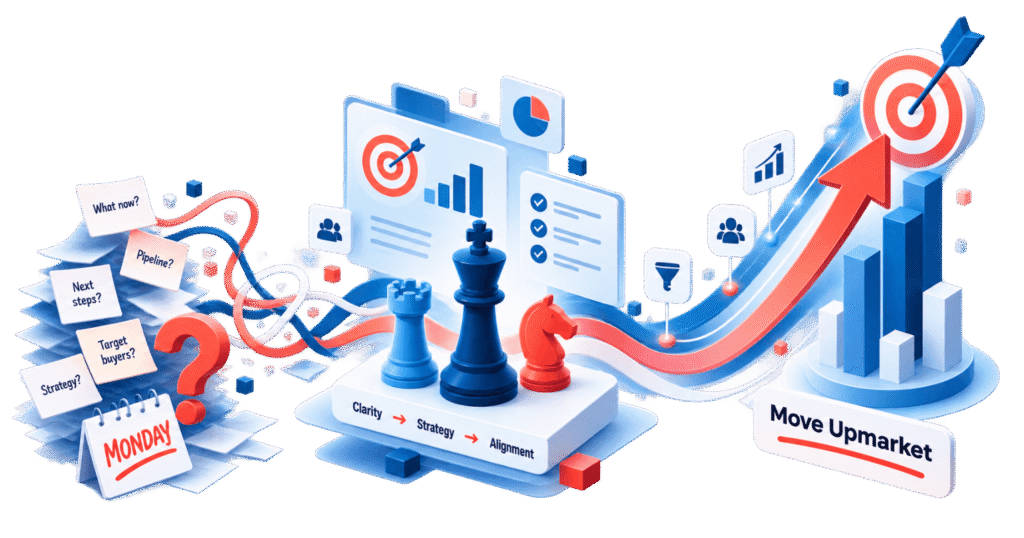
Strategy says: "Move upmarket."
Operating model defines: The account characteristics, buyers, messaging, qualification criteria, sales process, ownership, KPIs, and initiatives required to move upmarket.
Strategy says: "Improve pipeline quality."
Operating model defines: The forecast, segmentation, and territory view get rebuilt against what actually happened last quarter, not last year's assumptions.
Strategy says: "Improve Marketing and Sales alignment."
Operating model defines: The targets set at SKO get tracked against real pipeline and revenue data all year, not reviewed once when the number comes in short.
Otherwise "move upmarket" just sits in the deck until someone asks what it means for Monday's call list.
Each Decision Below Depends on the One Before It
ICP
Who should the company pursue?
BUYER
Who needs to be convinced?
POSITIONING
Why should the buyer choose the company?
QUALIFICATION
What makes demand commercially valuable?
PIPELINE
When does demand become a real opportunity?
OWNERSHIP
Who owns the next commercial action?
MEASUREMENT
Which numbers tell Leadership whether revenue is working?
PRIORITIES
What should the company do next?
Leadership and the revenue team end up working off the same map instead of comparing notes after the fact.
The Meetings Where Teams Argue About Whose Numbers Are Right Get a Lot Shorter.
BEFORE
- Different ICP definitions
- Different qualification standards
- Different pipeline interpretations
- Unclear handoffs
- Competing priorities
- Conflicting performance views
- Founder intervention across functions
AFTER
- One ICP
- One qualification standard
- One pipeline language
- Clear ownership
- Shared commercial KPIs
- Prioritized revenue initiatives
- A defined revenue management cadence
Your Revenue Strategy Stops Being a Slide Deck and Starts Being How the Company Actually Runs.
Noir Dove builds the operating model that connects market, buyer, positioning, demand, qualification, pipeline, ownership, measurement, and priorities, not another strategy document for leadership to review once and archive.
The company gains a shared commercial structure that Sales, Marketing, RevOps, and Leadership can use every week.
Everyone ends up running off the same numbers, the same definitions, and the same list of what matters next.
Why Noir Dove Builds This With You Instead of Just Handing You a Recommendation.
You can hire a RevOps admin to clean up CRM fields by next week. A firm that has actually run the handoffs, definitions, and cadences it recommends, inside a real revenue team, is rarer. Noir Dove builds the model with your team, on your CRM, until Sales, Marketing, RevOps, and Leadership are using it without a consultant in the room.


Ensures the operating model ties back to positioning and revenue strategy before it reaches your team, so the definitions Sales and Marketing inherit actually match the story the market is being told.

Leads the CRM and process work directly, building the funnel definitions, routing rules, and reporting cadence inside Salesforce, HubSpot, or whichever system your revenue data already lives in.
Cross-Functional Discipline
CRM & Process Depth
Executive-Ready Reporting
Faster Team Adoption
Fewer Dropped Handoffs
One Shared Number
Frequently Asked Questions (FAQs)
Is this the same as hiring a RevOps person?
No. A RevOps hire runs the system day to day. Noir Dove builds the definitions, ownership, and cadence that hire then runs, so the role has a model to operate instead of building one from scratch.
Do we need Revenue Intelligence before this, or instead of it?
It depends on what the Deep Clarity Assessment finds. Revenue Intelligence is scoped when the constraint is data and visibility. Revenue Operating Model is scoped when the constraint is how functions define and hand off work to each other. Some engagements need both, run in sequence.
How is this different from a CRM cleanup project?
A CRM cleanup fixes fields and records. It doesn’t decide what a qualified lead is or who owns the handoff when marketing passes a lead to sales. Noir Dove makes those commercial decisions first, then the CRM gets configured to hold them.
How long does building the model take?
Most engagements run 8 to 12 weeks from kickoff to a model your team is running independently, depending on how many of the six layers need to be built or rebuilt.
Does this replace our sales process, or work inside it?
It works inside it. Noir Dove defines the ICP, qualification, and handoff rules your existing sales process runs on. We’re not asking your team to adopt a new methodology, we’re making the one they already use consistent across functions.
Who actually builds and maintains the model after Noir Dove leaves?
Your team does. Both founders build the model with your Sales, Marketing, and RevOps leads in the room, not behind closed doors, so ownership sits with your people before the engagement ends.
The Founder Is Still the One Holding Marketing, Sales, RevOps, and Leadership Together.
Talk to Noir Dove founders directly. We’ll tell you whether the constraint is the operating model or something else.