
Revenue Intelligence
You Already Have the Data. Nobody Has Connected It to Why Your Revenue Stalled.
For deep tech founders at $1M to $20M ARR who have the data but not the explanation.
Customer, sales, pricing, and operations data usually already exists somewhere in your business. What is missing is the connection between them: why revenue slowed, where it is leaking, and where the next real opportunity sits. Revenue Intelligence is not where our engagements start. It is one of our execution solutions we scope once a Deep Clarity Assessment finds that the gap is a data problem, not a positioning or pipeline one.
Your Revenue Problem is Never Sitting in Just One Report
The constraint can sit in customer behavior, sales performance, pricing, demand, or operations, and it usually touches more than one. Most teams keep building new dashboards instead of connecting the ones they already have.
Almost every founder gets their read on revenue from what team leads report in a meeting, plus whatever each function’s own dashboard happens to show that week. That makes it hard to know how far the business is from its quarterly number until the finance close or the next SKO forces the question, and by then the gap is already too large to close quietly.
The gap that is costing you revenue is almost never the one you walked in thinking it was.
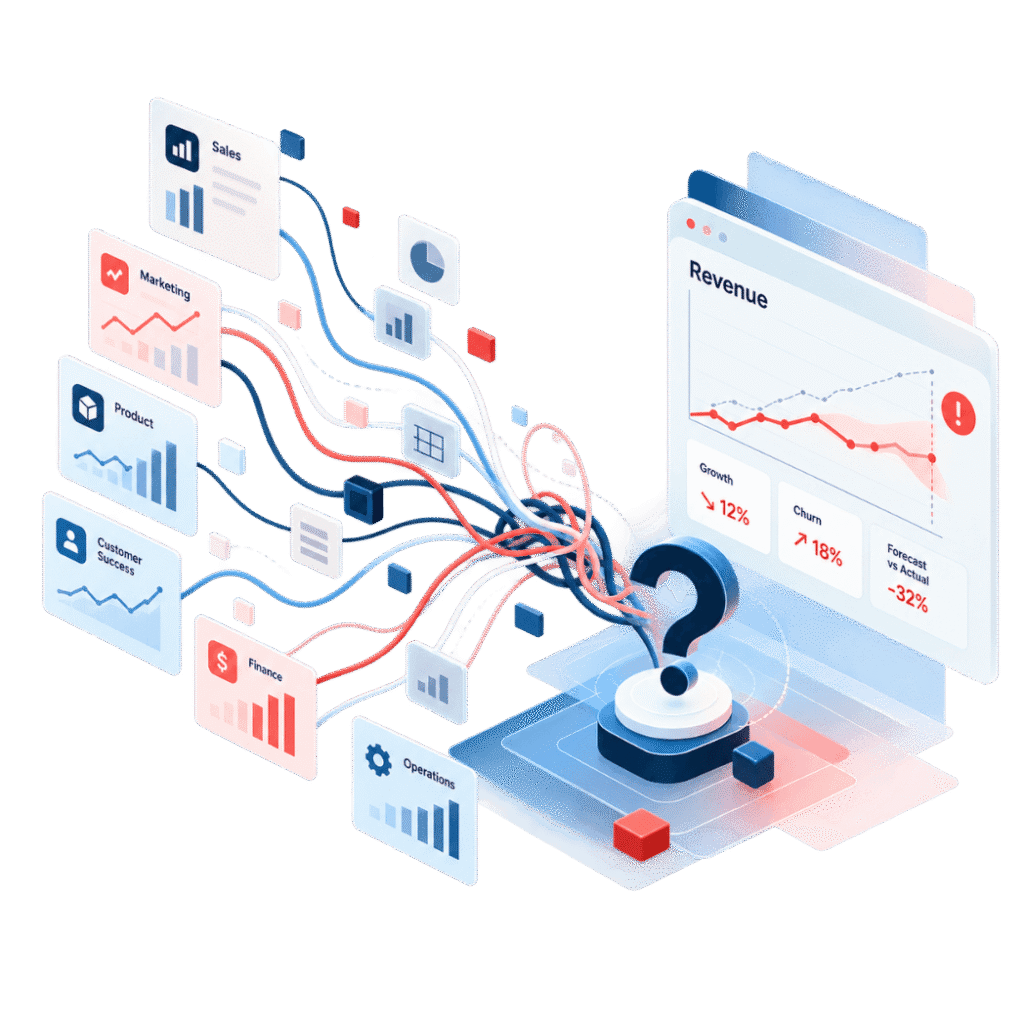
“Sales is closing deals and hitting quota, yet growth keeps slipping and churn climbs with nobody able to say why. Expansion revenue swings every quarter, discounts creep higher with nobody tracking the margin hit, and the forecast lands nowhere near what the quarter closes at, leaving you juggling three reports to answer one question about revenue.”
We Start With Clarity First.
Data Work Only Follows if that is the Fix.
Revenue Intelligence is one of our execution solutions, alongside Marketing, Sales, Product, & Governance solutions. We scope it only after a Deep Clarity Assessment finds that the missing piece is data & visibility, not positioning, pipeline, or alignment.
01
Deep Clarity Assessment
Surfaces whether the constraint is a data and visibility problem, not positioning, pipeline, or cross-functional alignment.
02
Strategy
Decides whether Revenue Intelligence is the right execution solution, and which of the areas it covers need it.
03
Alignment
Confirms your team can act on what the analysis finds. A dashboard nobody reads is not an outcome.
04
Execution (Intelligence)
Delivered in Guide, Train, or Manage mode, the same three modes as every other execution pillar. Structured to run every quarter alongside your goals, not delivered once and left to go stale.
Basic Clarity is included for every engagement, but Revenue Intelligence by definition means pulling data across marketing, sales, and product, not just one channel. That is exactly the threshold that calls for a Deep Clarity Assessment, so this solution is always scoped from that deeper tier, not Basic Clarity alone.
More Reports Never Get You Closer to the Answer
Revenue Growth
Customer & Retention
Revenue Forecasting
Forecasts built from actual customer behavior and demand patterns, not last quarter’s number plus a guess.
Pricing & Discounts
How pricing and discounting affect revenue, customer behavior, and margin, not just how much gets closed.
Sales & Territory Performance
Where sales performance, territory design, and account potential have drifted out of sync.
Operations & Capacity
Where fulfilment, inventory, delivery, or workforce capacity is quietly capping revenue.
Executive Overview
One view of the metrics leadership needs, pulled from Salesforce, HubSpot, or whichever CRM the data already lives in.
Analytics Automation & AI
Recurring analysis and reporting automated, so a business question does not sit in an analyst’s queue for a week.
Connect the Data and the Constraint Names Itself
Each data source on its own tells a partial story. Connected, the same data usually points to a specific, named constraint.
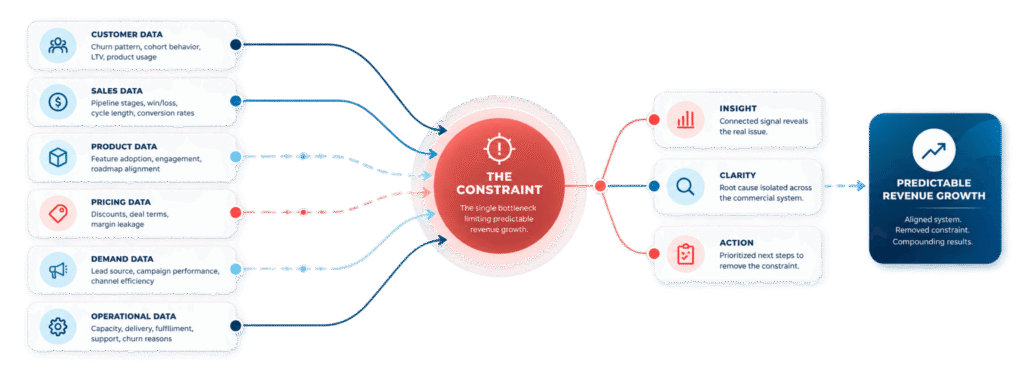
Customer Data
Churn pattern and revenue at risk
Which segments are churning, why, and what revenue is exposed if the pattern continues unaddressed.
Sales Data
Territory imbalance and missed opportunity
Where account potential and territory allocation have drifted apart, and what that gap is costing in pipeline.
Product Data
Dormant products and untapped potential
Which products are carrying the business, which are dead weight, and where the untapped revenue sits.
Pricing Data
Discount pattern and margin leakage
Where discounting has become the default instead of the exception, and what it is doing to margin.
Demand Data
Availability constraint and lost revenue
Where demand exists but supply, capacity, or timing is quietly costing closed revenue.
Operational Data
Capacity constraint and revenue limitation
Where fulfilment, delivery, or workforce capacity is the actual ceiling on growth, not demand or sales effort.
We Build What the Deep Clarity Assessment Found, Not a Standard Package.
A Revenue Constraint Map, an Opportunity Model, Customer Intelligence, Forecasting, an Executive Dashboard, or Analytics Automation. What gets built depends on where the constraint sits and what the Strategy phase prioritizes. Each one gets revisited on the review cadence below, not handed over once and left to go stale.
Revenue Constraint Map
A structured, ranked view of what is actually affecting revenue performance.
Revenue Opportunity Model
A quantified view of revenue at risk, revenue upside, and where to focus first.
Customer Intelligence
Segmentation, churn analysis, retention patterns, and accounts with real expansion potential.
Revenue Forecasting
Models and a working view for forward-looking revenue planning, built from your own data.
Executive Dashboard
One view connecting revenue performance to its drivers, built on your existing CRM, not a new system to maintain.
Analytics Automation
Automated reporting, self-serve analytics, and AI-enabled workflows where they replace manual analyst work.
We Do Not Hand You a Report and Disappear Until Next Year's Sales Kick-Off
Revenue targets get set once a year at SKO, then drift for four quarters while nobody checks whether the team is still on pace. Revenue Intelligence keeps that check running instead of retiring it into a slide deck the week after kickoff. Instead of relying on team leads and disconnected dashboards to guess the distance to goal, you get real-time visibility into current operations and a forecast that shows where the number is headed, not just where it stands today. That is what lets a founder make the call in month four instead of finding out in month twelve that the team missed what everyone signed up for at SKO.

Monthly Revenue Pulse
A short check against the forecast and the constraint map, so drift gets caught in weeks instead of surfacing at the next SKO.
Quarterly Recalibration
The forecast, segmentation, and territory view get rebuilt against what actually happened last quarter, not last year's assumptions.
SKO Revenue Goal Tracking
The targets set at SKO get tracked against real pipeline and revenue data all year, not reviewed once when the number comes in short.
One Set of Numbers, Not a Turf War
Sales, marketing, and product keep working from the same live view, so nobody is relitigating whose data is right in month nine.
A forecast nobody revisits is a guess with a due date.
Led by People Who Have Done This Inside a Business, Not Just Advised From Outside.
NoirDove founders bring 15+ years of analytics and operating experience across healthcare, cybersecurity, B2B commerce, distribution, and operations, before co-founding Noir Dove. The focus was always finding one specific, measurable action, not analysis for its own sake. That is the same standard every Noir Dove engagement is held to.

50%
Increase in upsell/cross-sell revenue via segmentation & retention analytics
80%
Reduction in revenue analytics pipeline incidents
0-45%
Adoption of self-serve analytics across business users
CRM Depth
Much of that work happens inside the CRM itself: Salesforce, HubSpot, and whatever other systems your revenue data already sits in, not just a reporting layer built on top of them. Getting marketing, sales, and product to trust the same numbers usually means fixing how the CRM is structured and used, not adding another dashboard. That is what gives a founder one cohesive view of revenue operations instead of checking a handful of disconnected tools to know where things stand.



Team Depth
Founders set the direction. The day-to-day work is run by data science specialists with deep GTM and revenue operations experience, who organize the underlying data and workflows so RevOps keeps running smoothly quarter over quarter, not just in the first month.
Frequently Asked Questions (FAQs)
Is this a BI tool implementation?
No. We are not implementing or selling a BI platform. Revenue Intelligence is an analysis and strategy engagement that may recommend tooling, but the deliverable is the finding and the action it points to, not a dashboard license.
Do we need clean data before this makes sense?
No. We first determine what data exists, what it can reliably answer, and where the gaps are. Most businesses we work with have imperfect data. That is normal, not a disqualifier.
Can we start with Revenue Intelligence instead of clarity work?
No. Every engagement starts with clarity. Basic Clarity is included for every client and confirms what you actually need. Because Revenue Intelligence means pulling data across marketing, sales, and product, that almost always calls for a Deep Clarity Assessment first. Revenue Intelligence is scoped only from what that assessment finds. We do not sell it as a standalone starting point.
How is this different from hiring a data analyst or BI consultant?
A data analyst or BI consultant usually answers the questions you already know to ask. We get brought in when leadership does not yet know which question is the right one, and the data needs to be connected across functions to find it.
What if the data shows something different from what we expected?
That is the common outcome. Founders usually walk in with a theory about where the constraint sits. We show you the evidence, not just the conclusion you were expecting.
Who works on the Revenue Intelligence engagement?
Both founders review scope and findings. Jagsir leads the underlying data and analytics work, alongside data science specialists who handle the day-to-day CRM and workflow organizing. Sakshi ensures the findings connect to positioning and revenue strategy before anything goes to your team.
Is this a one-time engagement?
Not usually. A single analysis can name the constraint, but revenue drifts every quarter as pricing changes, campaigns launch, and territories shift. Most engagements run on a quarterly cadence so the forecast and constraint view stay current instead of going stale the month after delivery.
You Already Have the Answer in Your Data. Start With Clarity to Find It.
Talk to both founders directly. We will tell you if Revenue Intelligence is the right execution solution, or if the constraint sits somewhere else entirely.