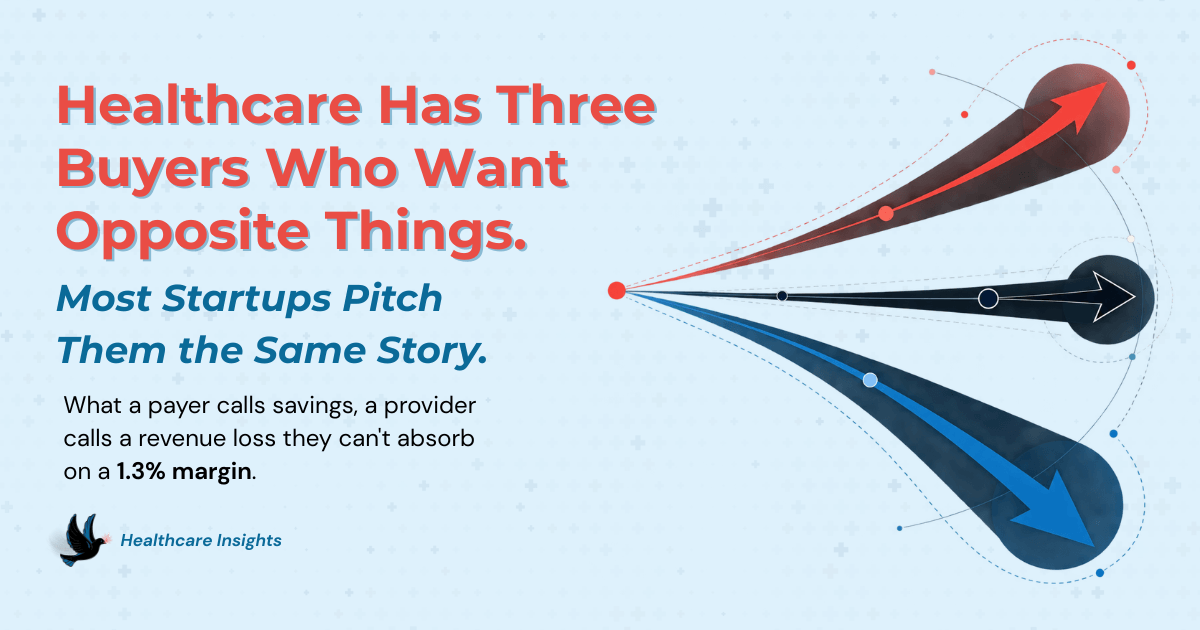
A payer wants fewer expensive claims. A provider needs more billable revenue to survive a median operating margin of 1.3%. A patient wants care that’s cheap and doesn’t require switching doctors.
Pitch all three the same story about “better healthcare” and every one of them will hear a different sentence, and only one of those sentences is actually good news for the person reading it.
Summary
- US hospitals closed out 2025 with a median adjusted operating margin of 1.3%, according to Kaufman Hall’s National Hospital Flash Report. A pitch that reduces utilization or visit volume is an existential threat to that margin, not a minor inconvenience.
- Oak Street Health built its entire GTM motion around one buyer, Medicare Advantage payers, aligning its own provider economics to that buyer’s incentives through capitation. CVS acquired it for $10.6 billion in 2023.
- Babylon Health tried to serve payers, providers, and patients simultaneously by acquiring capitated physician groups rather than building one clean buyer motion. It lost $221 million on $1 billion in revenue in 2022 and filed for bankruptcy in August 2023.
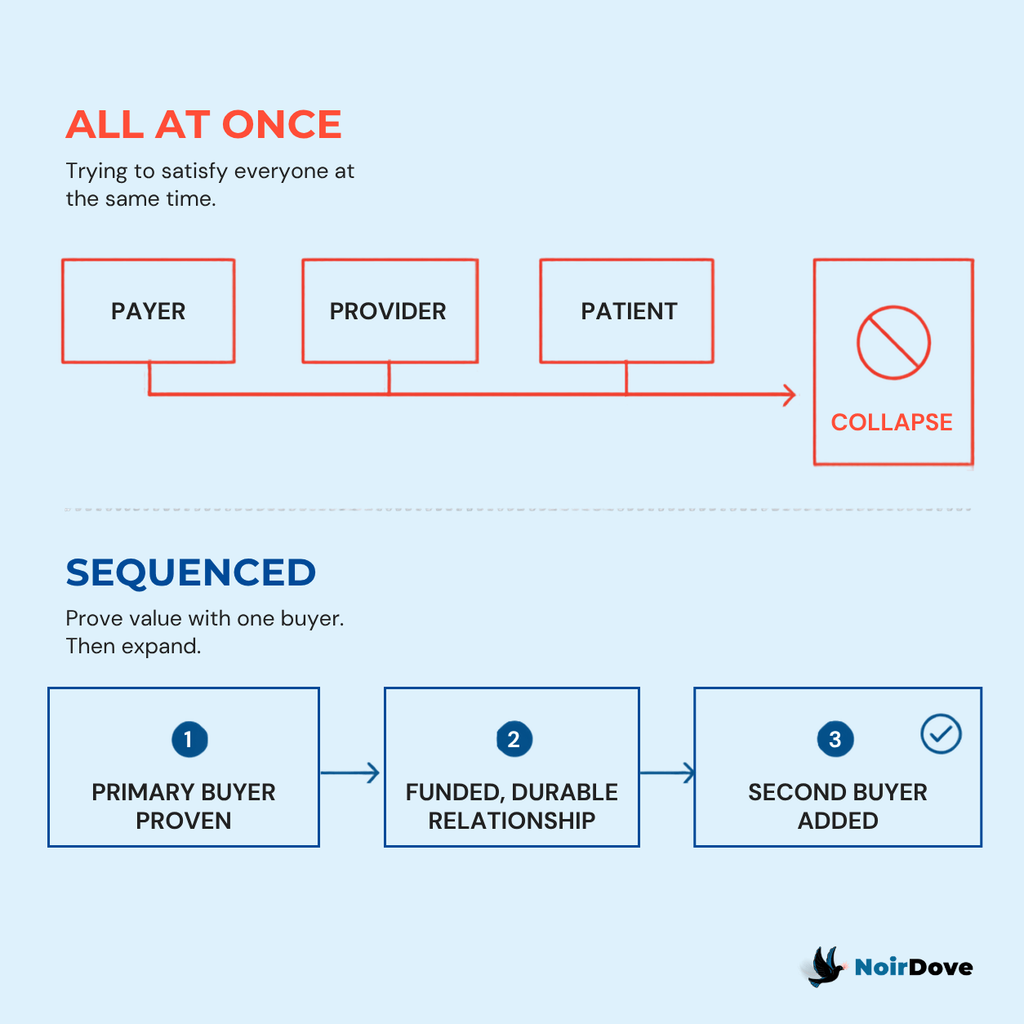
- A startup selling into US healthcare without picking a primary buyer first is running three sales cycles, three contract structures, and three messaging strategies on one GTM budget built for one.
TLDR
Payers, providers, and patients are not three segments of one healthcare buyer, they’re three buyers with opposing incentives. A pitch that lowers payer costs often means lower provider revenue, and providers operating on a 1.3% median margin (Kaufman Hall, 2025) can’t absorb that without walking away. Oak Street Health won by picking one buyer, payers, and designing its provider and patient experience around that buyer’s incentives, and CVS paid $10.6 billion for it. Babylon Health tried to serve everyone at once through acquisition shortcuts and went bankrupt in 2023. The founders who scale pick a primary buyer first, usually payer or provider, and treat the other two as secondary until the first relationship is proven.
Three Buyers, Three Definitions of “Better”
Ask a health plan’s chief medical officer what a “better” product looks like and the answer comes back in claims data: fewer emergency room visits, shorter hospital stays, lower per-member-per-month cost, and increasingly, better performance on the CMS Star Rating measures that determine a Medicare Advantage plan’s bonus payments. The payer’s whole business model is built on collecting a fixed premium and spending less than that premium on care. Every dollar of care avoided, without harming outcomes, is a dollar the payer keeps.
Ask a hospital or clinic administrator the same question and the answer is nearly the inverse. Providers get paid, in most of the country, for the volume and complexity of what they do, not for what they prevent. Kaufman Hall’s December 2025 National Hospital Flash Report put the median hospital operating margin at 1.3% year to date, including health system allocations for shared services, a figure the firm itself flagged as still historically thin even after a stronger year than 2023 or 2024. A hospital operating on a 1.3% margin does not have room to absorb a startup’s pitch to reduce ER visits or shorten length of stay unless something else fills that revenue gap. “Better” for a provider means more patients seen, more procedures billed, or the same volume delivered with less staff cost, not fewer visits.
Ask a patient, and “better” means something closer to what any consumer means by it: can I get an appointment this week, will it cost less than my last bill, and can I keep seeing the doctor I already trust. Patients respond to convenience and price, but they rarely switch providers on their own initiative, because switching means abandoning a relationship, a chart history, and a level of trust that took years to build. A patient who loves a cheaper, faster option still won’t use it if their existing doctor doesn’t recommend or accept it.
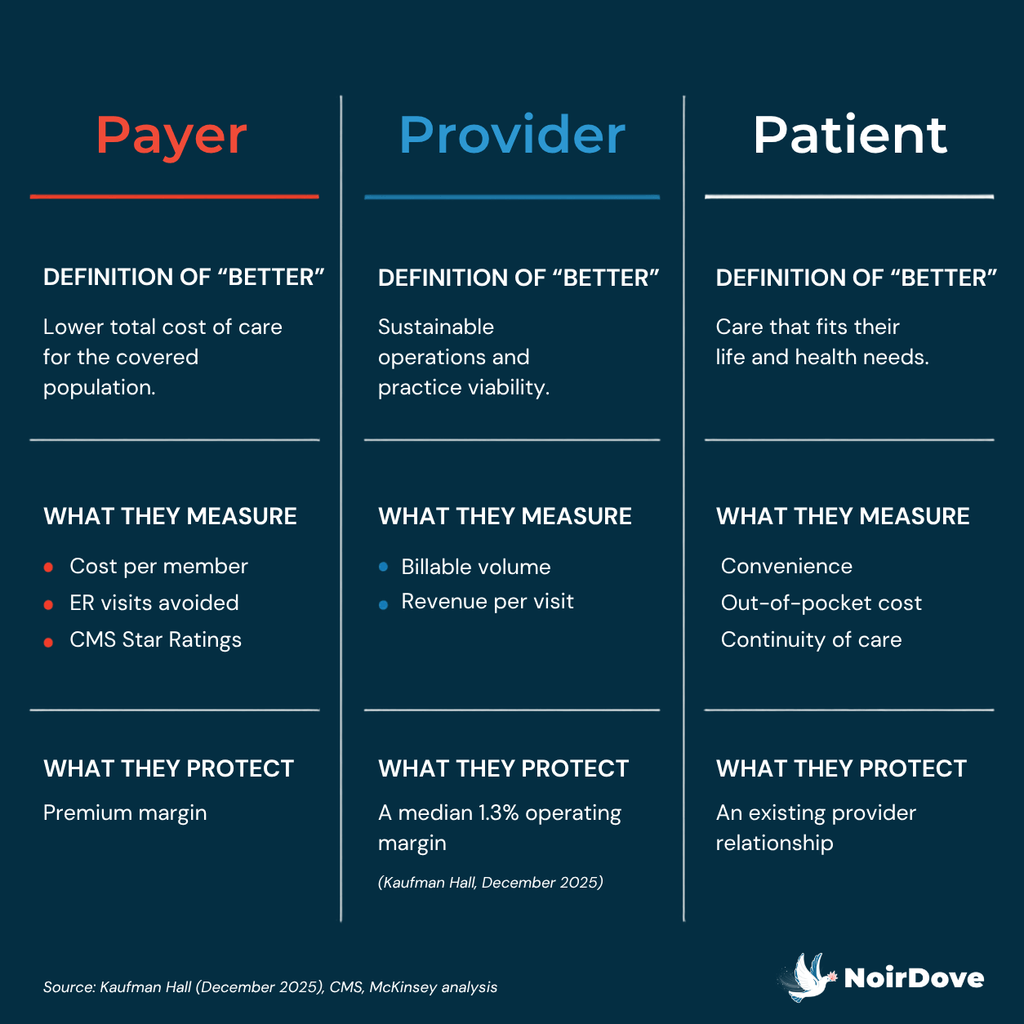
Three buyers. Three completely legitimate, completely self-interested definitions of what a healthcare startup’s product needs to deliver. None of them overlap by default.
“Reduces Expensive Care” Is Payer Language for “Reduces Provider Revenue”
This is where a single-story GTM plan breaks, and it breaks in a specific, predictable place. A startup pitching a payer on “we reduce unnecessary ER visits by 20%” is pitching a number the payer’s actuaries will love. That same number, delivered to the hospital whose ER those visits used to fill, describes a direct hit to billable volume at a facility already running on a 1.3% margin. The payer hears cost savings. The provider hears a threat to solvency. It’s the same sentence.
Win the payer relationship first, and the provider side of the deal often collapses on contact, because the hospital or clinic network the payer wants the product deployed through has no incentive to cooperate with something that shrinks their own revenue. Win the provider relationship first, building a tool that increases per-patient revenue or reduces staffing cost, and the payer may simply decline to reimburse it, because a tool built to help providers bill more is, from the payer’s seat, a tool that raises their claims cost, the exact thing they exist to avoid. And a product built purely around what patients want, cheaper, more convenient, better outcomes, still doesn’t move if the provider isn’t recommending it and the payer isn’t covering it, because patients follow their doctor’s referral pattern and their insurance’s provider network far more than they follow a better consumer experience alone.
These aren’t three GTM motions layered on top of each other. They’re three separate deals, negotiated with three parties whose financial interests point in different directions, and a founder who treats them as one market with three personas has already built the wrong org chart before a single sales call happens.
The GTM Budget Triples Before the Product Even Ships
Once a founder accepts that payers, providers, and patients are three buyers, not three audience segments, the GTM plan has to change shape entirely. Selling to a payer means a sales cycle built around actuarial proof, pilot data, and a contracting process that runs through a health plan’s medical policy and network teams, often 12 to 18 months before a signed deal. Selling to a provider means a completely different cycle: a hospital or health system’s IT, clinical, and revenue-cycle stakeholders, each with veto power, evaluating whether the product protects or threatens existing billing workflows. Selling to a patient is a consumer acquisition motion entirely, digital marketing, brand trust, out-of-pocket pricing that has nothing to do with either of the other two cycles.
Each of those requires a different sales team with different domain fluency, a different contract structure, capitation or per-member-per-month for a payer, a licensing or workflow-integration agreement for a provider, a subscription or cash-pay price point for a patient, and a different message that would actively damage the pitch to either of the other two buyers if it leaked into the wrong room. A founder who built a GTM budget assuming one sales motion has, without realizing it, committed to funding three, and most seed or Series A budgets were never sized for that.
Babylon Health is the clearest public example of what happens when a company tries to shortcut this by building for all three buyers at once through acquisition instead of through a proven single-buyer motion. Rather than proving one relationship, payer-aligned capitation, provider trust, or patient demand, before expanding, Babylon entered the US market by acquiring capitated physician groups at a rapid pace, including a book of business its own seller had already exited two years earlier for being financially undesirable. The company lost $221 million on $1 billion in revenue in 2022, its US losses nearly doubled again by mid-2023, and it filed for Chapter 7 bankruptcy in August 2023, having never actually proven that any one of its three buyer relationships, payer, provider, or patient, was durable on its own before trying to run all three simultaneously.
Pick the Buyer Whose Incentive You Can Actually Align With First
The founders who’ve built durable healthcare businesses generally didn’t try to solve for all three buyers at launch. They picked the one buyer whose financial incentive their product could genuinely serve, built the entire GTM motion, pricing, and even the clinical model around that buyer, and let the other two relationships follow once the first one was proven and funded.
Oak Street Health is the clearest example of getting this sequencing right. It built its entire clinical and financial model around one buyer: Medicare Advantage payers. Its primary care centers were designed from day one to succeed under a capitated, value-based contract, meaning Oak Street’s own revenue depended on keeping its patients healthy and out of the hospital, the exact outcome a Medicare Advantage payer is paid a bonus to achieve. That alignment made the payer sales motion straightforward, because Oak Street wasn’t asking a payer to trust a vague promise of better outcomes, it was proposing a financial structure where Oak Street only got paid well if the payer’s costs actually went down. Patient acquisition, free transportation, community-based clinics, senior-focused amenities, became a marketing layer built on top of an already-proven payer relationship, not a separate GTM motion competing for its own budget. Oak Street still operated at a loss through 2023, over $200 million that year alone, with profitability targeted for 2025 at the earliest, proof that even the right sequencing doesn’t guarantee an easy path. But CVS paid $10.6 billion for the model anyway, because the underlying buyer alignment, not the growth rate, was what made the business durable enough to bet on.
Livongo ran a similar play from the employer and payer side. Before its $18.5 billion merger with Teladoc in 2020, Livongo built its diabetes management business by selling directly to self-insured employers and health plans, the parties who directly bore the cost of poorly managed chronic disease, and priced its product around the medical cost savings those buyers could measure. Patients received the connected glucose meters and coaching for free, because the employer and payer were footing the bill, precisely the pattern that removes the patient-acquisition problem entirely by making it someone else’s job to distribute the product.
Patient-first is not an impossible path, but it comes with a lower ceiling that founders should walk into with open eyes. Direct-to-consumer telehealth companies like Hims & Hers built real, profitable businesses by deliberately staying outside insurance entirely, cash-pay only, no payer negotiation, no provider network dependency, trading a much smaller addressable spend per patient for a dramatically simpler, faster sales cycle. That’s a legitimate strategy. It’s also a different company than one trying to eventually sell into Medicare Advantage or a hospital system, and founders who start patient-first while quietly hoping to “add payer revenue later” are usually underestimating how completely that second buyer’s incentives require rebuilding the product’s economics from scratch.
The lesson underneath all three examples is the same. Identify which buyer’s financial incentive your product can genuinely and provably serve, not which buyer would theoretically benefit from your product existing. Build the GTM motion, the pricing, and in Oak Street’s case the entire clinical model, around that one buyer’s actual math. Only once that relationship is funded and proven does it make sense to build the second story, and the second sales team, for whichever buyer comes next. A founder trying to write all three stories in year one isn’t being ambitious. They’re running three startups on one company’s cash, and most companies don’t have three startups’ worth of runway.
FAQs
Can a healthcare startup ever pitch payers and providers the same story if their product genuinely benefits both? Rarely, and only when the product changes who captures the savings, not just how much is saved. A tool that helps a provider get paid more accurately for value-based care they’re already contractually obligated to deliver, rather than one that simply reduces the volume of billable services, can align both sides, because the provider isn’t losing revenue, they’re capturing revenue they were already owed under a risk-based contract. Products that reduce utilization without changing the underlying payment model will almost always split the two buyers’ interests.
Why did Oak Street Health need to be acquired instead of reaching profitability on its own? Value-based primary care requires years of upfront investment, more staff time per patient, additional care coordination, community outreach, before the downstream savings materialize as bonus payments from a payer. Oak Street was still posting nine-figure annual losses as of 2023 while it scaled that model nationally. CVS’s $10.6 billion acquisition wasn’t a bet on near-term profitability, it was a bet that the payer-aligned model, once at scale inside a company with Aetna’s existing Medicare Advantage book, would become durably profitable faster than Oak Street could get there alone.
Is patient-first GTM ever the right starting point for a startup that eventually wants payer or provider revenue? It can work as a proof-of-demand stage before a harder pivot, but founders should treat it as a different business, not an early phase of the same one. The pricing, clinical validation, and sales motion required to satisfy a payer or a large provider system are substantially different from what wins direct-to-consumer, cash-pay customers, and a startup that raised its seed round on patient-first metrics often has to rebuild its unit economics and evidence base almost entirely to make the payer or provider pitch credible.
How does a founder figure out which buyer, payer or provider, to start with? Start with whichever buyer’s existing financial incentive your product most directly and provably improves, and whichever buyer’s sales cycle your current funding can actually survive. A capitation-ready model with strong outcomes data usually points toward payers first, since payers reward avoided cost directly. A workflow or revenue-cycle tool that makes an existing billable service faster or more accurate usually points toward providers first, since it doesn’t require asking a thin-margin buyer to accept less volume.
Sources Referenced
- Kaufman Hall, “National Hospital Flash Report,” December 2025 data, via Fierce Healthcare and HealthLeaders, February 2026
- Healthcare Dive, “CVS buys Oak Street Health for $10.6B,” February 2023
- Fierce Healthcare, “CVS closes $10.6B acquisition of Oak Street Health to expand primary care footprint,” May 2023
- Healthcare Dive, “CVS closes $10.6B Oak Street Health buy,” May 2023
- Hospitalogy, “The Downfall of Babylon Health,” March 2024
- Forbes, “Digital Health Company Babylon Files For Bankruptcy In U.S., Will Liquidate,” August 2023
- Becker’s Hospital Review, “How Babylon Health went from $2B to bankrupt,” August 2023
Talk to Noir Dove
If your GTM plan is telling one story to three buyers with opposite incentives, the story isn’t the problem, the sequencing is. Noir Dove diagnoses which buyer your commercial system can actually serve first, before you fund three sales motions on one company’s runway. Book a Clarity Call. One conversation, before the payer pitch quietly kills the provider deal you already had in motion.