
Key Takeaways
- Your commercial system isn’t a department. It’s the connective tissue between marketing, sales, and customer success. Break the connections, and every function can look fine while growth doesn’t.
- If you’re patching symptoms, you’re treating the wrong patient. New hire, new tool, new campaign. None of it works because none of it was the actual disease.
- A VP of Sales can’t lead a system that doesn’t exist. Talent inherits structure. Bad structure breaks good talent.
- Referrals aren’t a growth strategy. They’re a sign you haven’t built one yet.
- Sales and marketing aren’t fighting because of personality. They’re fighting because nobody defined what “qualified” means.
- Churn rarely starts at the exit. It starts at the sale, in a mismatch nobody was diagnosing for.
- More leads into a broken funnel is not growth. It’s faster leakage.
- If every quarter feels like day one, your system has no memory. And a system that doesn’t remember can’t improve.
- The fix isn’t more effort. It’s diagnosis. You don’t need to work harder inside a broken system. You need to know exactly where it’s broken.
Business Growth Stalled: A Founder’s Nightmare
There is a particular kind of frustration that comes with running a B2B company past $1M ARR. You have customers, a product that works and a team. And yet, somewhere between where you are and where you thought you’d be by now, growth stopped compounding the way it used to.
So you did what any reasonable founder does. You looked for the problem.
Maybe you found it in your sales team, in your marketing output and decided the positioning was off, or the market had shifted, or you just needed better people. You made changes. You hired, restructured, rebranded, or reinvested. And the results were… fine. Incremental at best. The underlying feeling didn’t go away.
Here’s what most founders in that position don’t yet know: they were diagnosing the right pain in the wrong place.
What a Commercial System Actually Is?
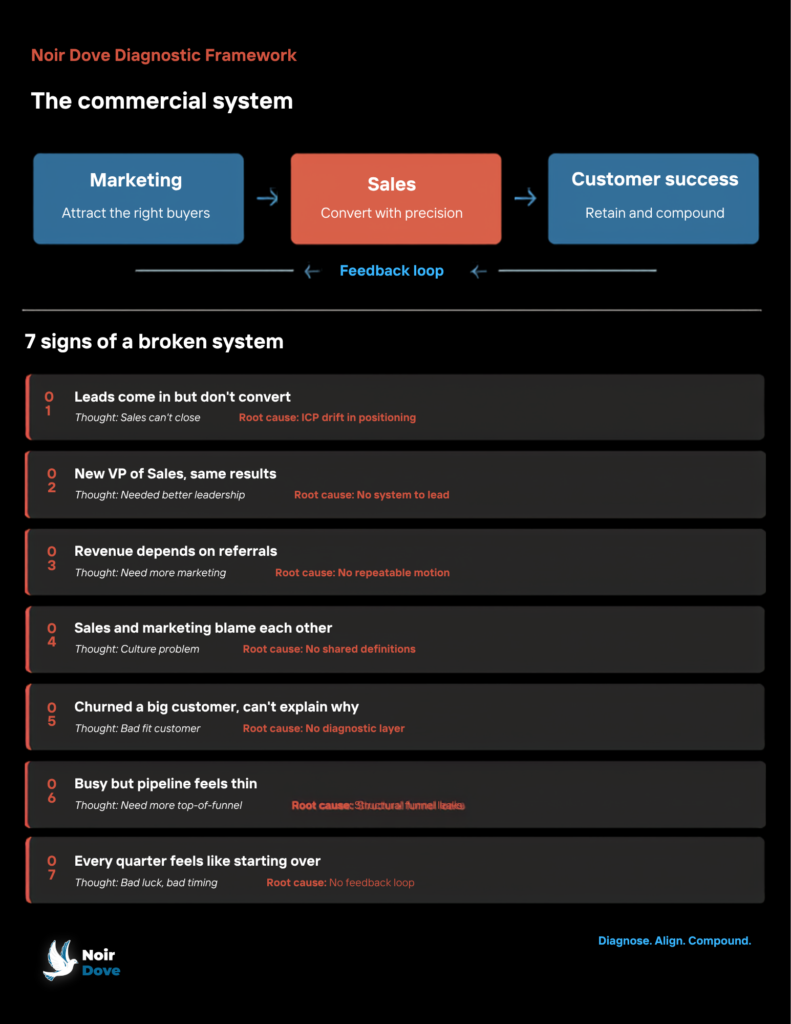
A commercial system is not a department, not your CRM, your marketing stack, or your sales playbook in isolation. It is the interconnected engine through which your business finds the right buyers, earns their trust, converts them into customers, and keeps them long enough to grow from them.
It spans three functions: marketing, sales, and customer success. But the system is not the functions themselves. It is the way those functions connect, hand off, share information, and operate toward a common definition of growth.
When the system is working, revenue compounds. Leads that marketing generates are leads that sales can close. Customers that sales closes are customers that success can retain. Insights from retention flow back into positioning. The whole thing builds on itself.
When the system is broken, each function can look reasonably healthy in isolation while the overall output underperforms. That is what makes it so hard to diagnose from the inside. You are looking at the parts. The problem lives in the connections.
Why Founders Don’t See It
You didn’t build your company as a system. You built it function by function, hire by hire, quarter by quarter. Marketing came first, or sales did, or maybe you were doing both yourself until it became unsustainable. Each piece was added to solve an immediate problem, not to integrate into a coherent whole.
So when something breaks, the instinct is to look at the most recent addition, or the loudest symptom, or the function that missed its number. You look at the part. And the part, examined in isolation, almost always has a plausible explanation and a plausible fix.
This is the trap. And it is expensive. B2B companies at your stage typically spend 40 to 60 percent of revenue on sales and marketing before they reach scale. A significant portion of that spend lands on symptoms, not root causes, because the root cause was never diagnosed.
The Signs Your Commercial System Is Broken
These are not hypotheticals. They are patterns that show up repeatedly in companies between $1M and $10M ARR companies with real revenue, real teams, and real confusion about why growth has stalled.
Sign 1: Leads are coming in but not converting
What you thought: the sales team isn’t closing well enough. Maybe they need better training, a stronger script, a different incentive structure.
What is actually happening: your marketing is attracting buyers who are adjacent to your ideal customer but not quite them. The ICP has drifted, or the messaging is resonating with the wrong segment. No amount of sales coaching fixes a positioning problem.
Sign 2: You hired a VP of Sales and nothing changed
What you thought: you needed stronger sales leadership to unlock the next phase of growth.
What is actually happening: there was no functional commercial system for them to lead. They inherited undefined handoffs, a pipeline with no agreed qualification criteria, and a marketing function operating on different assumptions. Sales leaders are talented. They are also building on sand.
Sign 3: Your best customers almost all came through referrals and nothing changed
What you thought: you need to invest more in marketing to build pipeline beyond referrals.
What is actually happening: you do not yet have a repeatable commercial motion. Referrals work because trusted relationships carry the trust that your system has not yet learned to generate at scale. More marketing spend does not solve a motion problem.
Sign 4: Marketing and sales are always blaming each other
What you thought: you have a people problem, a culture problem, maybe a leadership problem.
What is actually happening: there is no shared definition of a qualified lead, an ideal customer, or what a successful handoff looks like. The blame is structural, not personal. When two functions are operating from different playbooks, friction is the only possible output.
Sign 4: Marketing and sales are always blaming each other
What you thought: you have a people problem, a culture problem, maybe a leadership problem.
What is actually happening: there is no shared definition of a qualified lead, an ideal customer, or what a successful handoff looks like. The blame is structural, not personal. When two functions are operating from different playbooks, friction is the only possible output.
Sign 5: You churned a significant customer and could not fully explain why
What you thought: they were a difficult fit, or the timing was wrong, or the market shifted on them.
What is actually happening: the misalignment between what was promised in the sale and what was delivered in the relationship was never visible until it became churn. The system had no diagnostic layer that could surface the signal earlier.
Sign 6: You are busy but pipeline always feels thin
What you thought: you need more top-of-funnel volume. More content, more outreach, more activity.
What is actually happening: your funnel has structural conversion problems. Adding volume to a leaking funnel accelerates the leak. The constraint is not input; it is the loss happening between stages that nobody has mapped or measured.
Sign 7: Every quarter feels like starting from scratch
What you thought: seasonality, market conditions, an unlucky stretch.
What is actually happening: nothing in your commercial system is compounding. Insights from closed deals are not feeding back into positioning. Patterns from churned customers are not informing ICP. Each quarter begins without the institutional memory of the last one. A system with no feedback loop has no way to improve.
The Pattern Behind All of It that Founders Miss
Seven signs, one root cause. Functions operating without a shared diagnostic framework, without agreed definitions, and without the feedback loops that would allow the system to learn and improve over time.
This is not a people failure. The founders navigating this built real companies. The marketers, salespeople, and CS leads inside them are often genuinely capable. The failure is structural — and structural problems do not respond to personnel solutions.
The data supports this at scale. Growth rates for B2B SaaS companies in the $1M to $5M ARR band dropped by roughly 50 percent year over year in 2025. That is not a talent crisis across an entire cohort. That is a systems crisis that the cohort has not yet named.
What Knowing This Gap Changes for Founders
When you recognize the problem as systemic, the entire approach to fixing it changes. You stop asking “which function is underperforming” and start asking “where is the system losing alignment.” Now you are not making isolated hires to patch isolated symptoms. As a founder, you now start with a diagnosis.
Diagnosis is not analysis for its own sake. It is the work that tells you exactly where to intervene, in what order, and why — so that whatever you build next compounds rather than corrects.
Does any of these signs feel familiar to you?
A Clarity Call with Noir Dove costs you nothing except thirty minutes and a willingness to look at the system, not just the symptoms. No pitch, no proposal, no obligation. Just a structured conversation about what is actually driving the stall.
Book Your Clarity Call Below 👇