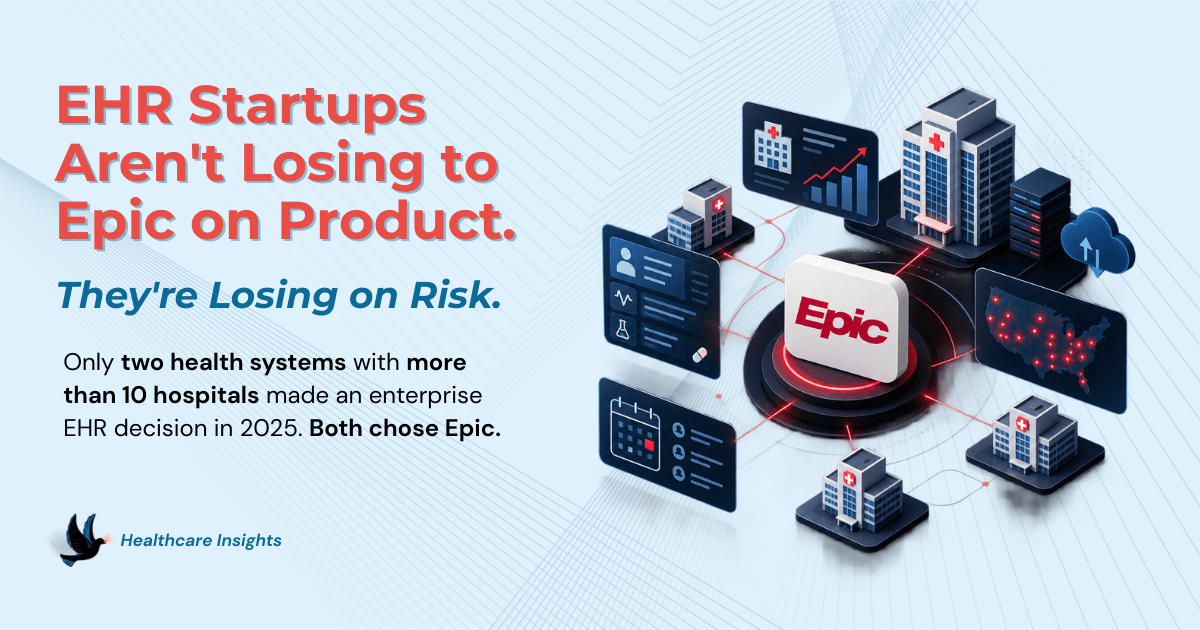
Every EHR startup pitch deck says some version of the same thing: cloud-native, faster to implement, built by people who’ve actually used the product they’re selling, a fraction of the cost of the incumbent. All of that can be true. Epic still gained a net 568 hospitals since 2021. Oracle Health, backed by one of the largest software companies on earth, lost 173 in the same window. The startups aren’t losing a product contest. They’re losing a risk contest, and almost none of them are pitching to the question the buyer is actually asking.
Summary
- Epic controls 43.7% of the US acute care hospital EHR market and 56.9% of hospital beds as of KLAS Research’s 2026 report, up from 42.3% and roughly 55% a year earlier.
- Among health systems with more than 10 hospitals, only two made an enterprise-wide EHR decision in 2025. Both chose Epic. No other vendor, including Oracle Health, was selected in a decision of that size.
- The VA’s Oracle Cerner rollout, originally a $10 billion, 10-year contract, now carries a lifecycle cost estimate of roughly $37 billion, with more than 800 major performance incidents recorded since 2020, over half of them after a three-year pause the department imposed in April 2023.
- Even a hospital that chooses the “safe” incumbent isn’t safe from disaster: Maine Medical Center’s $160 million Epic rollout in 2013 produced billing errors severe enough to cost the hospital $13.4 million in six months.
TLDR
Modern EHR startups keep losing enterprise hospital deals to Epic despite building objectively better software, because hospital CIOs aren’t buying features, they’re buying insurance against becoming the next VA or Maine Medical Center. Epic holds 43.7% of the acute care market and won both enterprise-wide decisions made by systems with more than 10 hospitals in 2025. The startups that have actually built durable, funded businesses in this space, Elation Health and Canvas Medical among them, didn’t try to win that fight. They built for independent primary care and value-based care groups, the segment Epic has never optimized for, where the switching decision doesn’t carry a hospital’s entire clinical operation on its back.
Epic’s Lead Isn’t Shrinking. It’s the Only Vendor Large Buyers Will Even Consider.
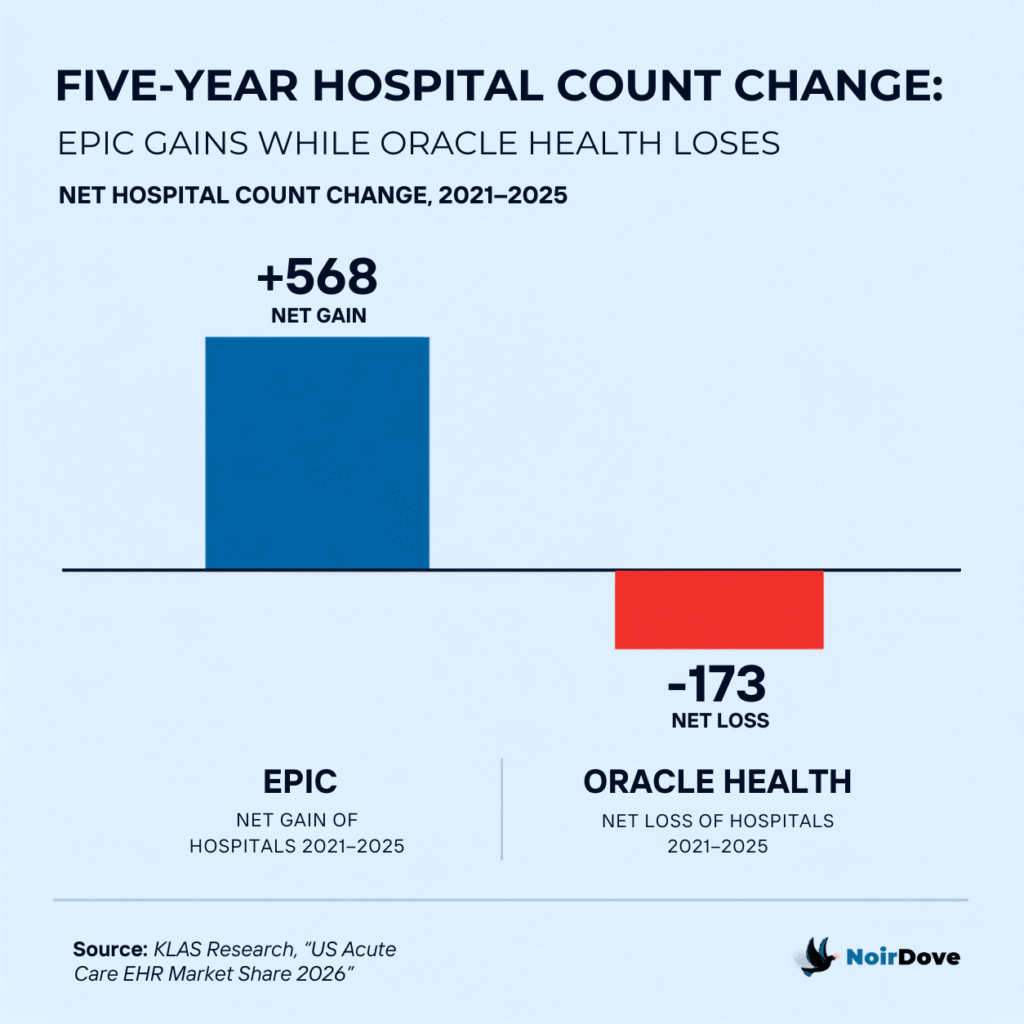
KLAS Research’s “US Acute Care EHR Market Share 2026” report, released in May 2026, puts a number on something health-tech founders often treat as an assumption rather than a fact. Epic ended 2025 with 43.7% of the acute care hospital market and 56.9% of hospital beds, a five-year gain of 568 net hospitals since 2021. Oracle Health, the vendor built on the $28.3 billion 2022 acquisition of Cerner, lost a net 56 hospitals and 14,676 beds in 2025 alone, its third consecutive year of decline, and lost 173 hospitals over the same five-year window Epic gained 568.
The number that should stop a founder mid-pitch-deck is this one: among health systems with more than 10 hospitals, only two made an enterprise-wide EHR decision in all of 2025. Both chose Epic. No other vendor, not Oracle, not Meditech, not a startup, was selected in a decision of that scale. That’s not a market Epic is winning. It’s a market where large buyers have functionally stopped considering an alternative.
Smaller health systems still make decisions, and that’s where the actual competitive activity in 2025 happened. But even there, Epic added 77 hospitals while nearly every other vendor lost ground, and KLAS reported the customer base fleeing Oracle Health went almost entirely to Epic, not to a challenger. Meditech held onto its own customers at record rates, 84% of Meditech customers making a platform decision chose to stay on Meditech’s newer Expanse system, up from 63% the year before, which tells you something too: even dissatisfaction doesn’t reliably send a hospital toward something new. It sends them toward whichever option looks least likely to become a five-year crisis.
Why a Hospital CIO Optimizes for Not Becoming the Next Headline, Not for the Best Interface
The VA’s Oracle Cerner rollout is the clearest public case study of what a hospital system’s leadership is actually afraid of, and it has nothing to do with whether the software’s UI is dated.
The VA signed its original contract with Cerner in 2018 at $10 billion over 10 years. By 2025, the lifecycle cost estimate given to Congress had grown to roughly $37 billion, with some independent estimates running as high as $50 billion. The system has recorded more than 800 major performance incidents since its first deployment in 2020, over half of them occurring after the VA paused all new rollouts in April 2023 to address patient safety concerns. A March 2025 GAO report found that only 13% of VA staff using the new system believed it made the department more efficient, and 58% believed it had increased patient safety risk. The rollout is now scheduled to resume in 2026, eight years after the original contract was signed and roughly 27 years ahead of when the original 10-year timeline was supposed to finish.
Here’s the part that matters for a startup’s GTM plan: this isn’t a story about Oracle Health being a uniquely bad vendor. It’s a story about what happens when a EHR transition goes wrong at any hospital system, regardless of which vendor is involved. Partners Healthcare’s Epic implementation in Boston ran to $1.2 billion and took years, and its own CIO described it not as an IT project but as “a business transformation for your clinical systems, your clinical user.” Maine Medical Center chose Epic too, the vendor every risk-averse buyer defaults to, and still lost $13.4 million in the first six months after its December 2013 go-live because the system wasn’t properly configured for billing and charge capture. If the safe choice can still produce an eight-figure loss inside two quarters, a hospital CIO evaluating an unproven startup isn’t asking whether the product is better. They’re asking what happens to the hospital’s revenue cycle, patient safety record, and their own job if the migration goes even half as badly as Maine’s did.
That’s the buyer a startup is actually pitching. Not a person evaluating software. A person whose career, and in some cases whose hospital’s solvency, is downstream of a decision that takes years to reverse once made.
The GTM Budget That Never Gets Named as GTM Spend
A startup selling into this market spends its GTM budget the same way a health-tech founder chasing FDA clearance spends theirs: on an asset the pitch deck calls something else. Here, it’s not a clinical trial. It’s the implementation guarantee, the migration support team, the years of reference customers a hospital board wants to see before they’ll sign, none of which shows up on a typical SaaS sales cost line, and all of which Epic has spent three decades building at a scale no startup’s Series B can match.
This is why the enterprise hospital segment has effectively become closed to new entrants, and why founders who keep pitching into it are burning capital against a buyer whose actual purchasing criteria they haven’t priced into their plan. The product comparison a startup wants to have, faster, cheaper, better designed, is real and often true. It’s also not the comparison the buyer is running. The buyer is running a comparison against the VA’s $37 billion outcome and Maine’s $13.4 million loss, and a three-year-old startup with forty hospital customers doesn’t have the reference base to win that comparison, no matter how good the software is.
Elation Health and Canvas Medical Didn’t Try to Win the Fight Epic Already Owns
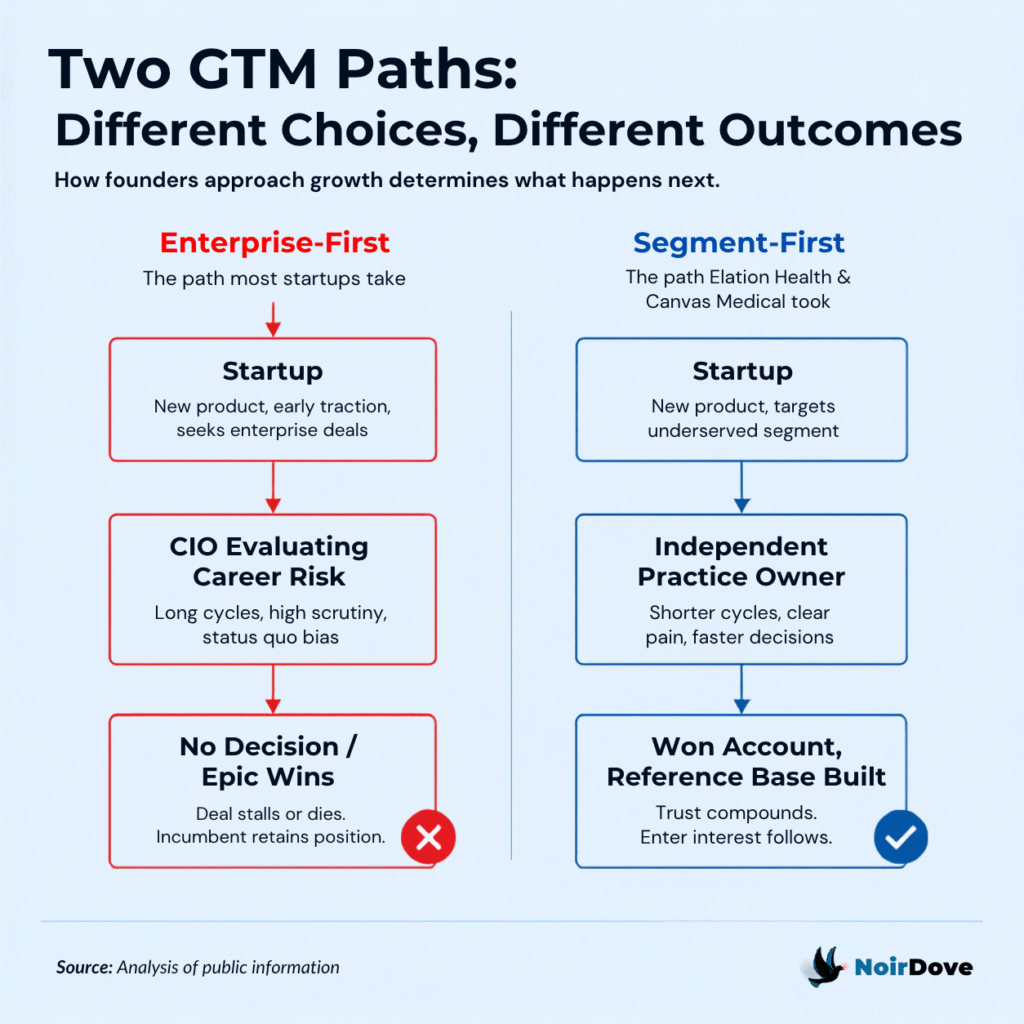
The EHR startups that have actually built durable, funded businesses over the past decade mostly stopped trying to displace Epic in the segment Epic owns. Elation Health, founded in 2010, has raised $108.5 million and built its entire platform around independent primary care, connecting more than 21 million patients to over 40,000 clinicians, and won a Best in KLAS award for 2026 in that specific category, not in acute care. Canvas Medical, founded in 2015, raised $64 million building an ONC-certified EMR and revenue cycle platform specifically for ambulatory and value-based care organizations, with a FHIR API and Workflow SDK positioned as infrastructure other developers build on top of, not a head-to-head Epic replacement pitch.
Neither company is trying to win the decision that only two health systems made in all of 2025. They’re selling into a segment, independent primary care and value-based care groups, where the switching cost is a fraction of a hospital’s, the buyer is a practice owner or a small group, not a CIO answerable to a board, and Epic has never built the sales motion or pricing model to compete for that customer in the first place. That’s not a smaller ambition. It’s a correctly diagnosed one.
The framework underneath this is straightforward, and it applies to any founder building GTM strategy against an incumbent with decades of institutional trust behind it. Identify what the buyer is actually protecting against, not what they say they want improved. Find the segment where the cost of being wrong is measured in thousands of dollars and a few weeks of disruption, not tens of millions and a multi-year board-level crisis. Build the reference base and implementation trust there first. The enterprise hospital contract Epic has locked up isn’t a market a startup loses by building worse software. It’s a market a startup was never actually competing in, no matter what the pitch deck said, because the buyer was never evaluating the product at all.
FAQs
If Oracle Health, backed by one of the largest cloud and enterprise software companies in the world, can’t win back hospital market share from Epic, what chance does a startup have? Realistically, close to none in the specific segment where enterprise-wide, more-than-10-hospital decisions get made. Oracle’s struggles prove the barrier isn’t capital or engineering talent, it’s the accumulated implementation trust, reference base, and workforce training pipeline Epic has built over decades. A startup’s chance isn’t in that segment. It’s in the segments Epic has never prioritized: independent practices, value-based care groups, and interoperability infrastructure that sits alongside the incumbent rather than replacing it.
Does KLAS data suggest hospitals are happy with Epic, or just afraid of switching away from it? Both, and the two aren’t mutually exclusive. KLAS has repeatedly cited Epic’s reputation for partnership and follow-through as a driver of its wins. But the data also shows dissatisfaction doesn’t translate into openness to new vendors, it translates into consolidation toward the vendor perceived as lowest-risk. Nearly a third of Oracle Health’s own customers told KLAS the platform isn’t part of their long-term plans, and most of them are still not choosing anyone other than Epic when they do decide to leave.
Is there any path for a startup to eventually win large hospital system contracts, or is that segment permanently closed? It’s not permanently closed, but it won’t be won by pitching a better interface. A startup would need to first build the kind of implementation track record, reference customer base, and financial guarantees that only come from years of successfully serving smaller, lower-risk accounts, the exact strategy Elation Health and Canvas Medical are running. The path to the enterprise hospital contract runs through the segment Epic doesn’t compete for, not around it.
Should a startup avoid mentioning Epic or Oracle Health at all in its positioning if it isn’t targeting large hospital systems? Generally, yes, beyond factual comparison where relevant. Positioning a small primary care EHR as an “Epic alternative” invites a comparison on Epic’s terms, implementation scale, reference base, financial backing, that the startup will lose. The stronger position names the buyer and the workflow the startup actually serves, independent practices, value-based care, virtual-first models, and lets the product speak to that buyer’s actual switching cost, not Epic’s.
Sources Referenced
- KLAS Research, “US Acute Care EHR Market Share 2026,” via HealthSystemCIO, May 2026
- Becker’s Hospital Review, “Epic up by 77 hospitals: 8 things to know,” May 2026
- Fierce Healthcare, “Epic continues to grow EHR market share as it makes gains among small health systems,” May 2026
- HIT Consultant, “KLAS 2026 EHR Market Share Report: Epic Gains as Oracle Health Faces Third Year of Losses,” May 2026
- Nextgov/FCW, “VA readies to restart EHR deployments in 2026, despite lingering lawmaker unease,” December 2025
- Federal News Network, “VA EHR rollout resumes after three-year pause,” April 2026
- Government Executive, “Lawmakers question VA health record’s costs and batched deployments,” December 2025
- Sarah Gebauer, MD, “The financial impact of AI in health” (Maine Medical Center and Partners Healthcare EHR implementation case data)
- Startup Intros, Elation Health and Canvas Medical funding and platform data, 2026
Talk to Noir Dove
If your GTM plan is pitching a better product to a buyer who’s actually evaluating risk, the pitch was never going to land, no matter how good the software is. Noir Dove diagnoses who your buyer actually is and what they’re protecting against before you spend another quarter chasing a deal you were never positioned to win. Book a Clarity Call. One conversation, before the next enterprise sales cycle burns another two quarters on a buyer who was never going to say yes.