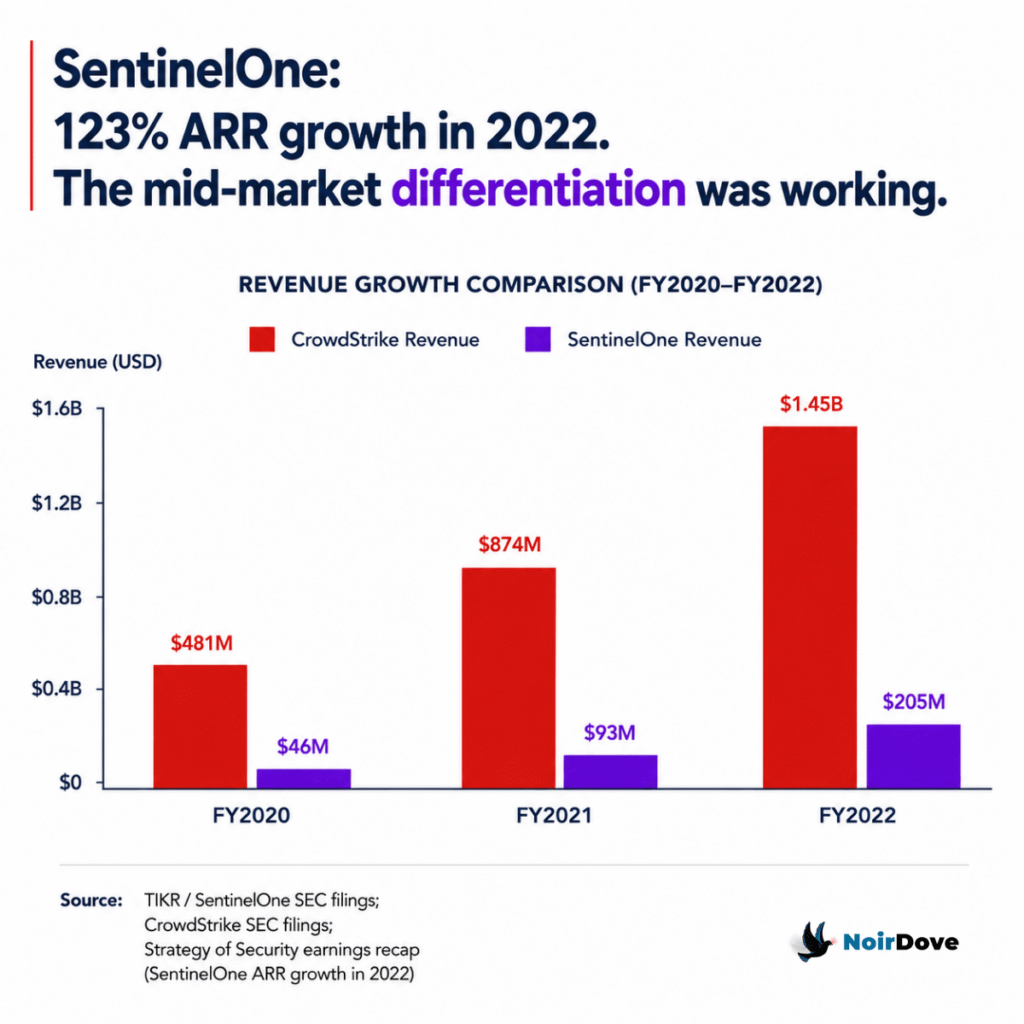
Competitive positioning has a shelf life. SentinelOne proved this by accident. In 2020, it built its entire go-to-market around a single premise: CrowdStrike’s capabilities, at a price the mid-market could actually pay. SentinelOne’s revenue doubled to $93.1 million in fiscal 2021, and it ended the year with a net revenue retention rate of 117%, numbers that looked like vindication of the strategy. Three years later, SentinelOne’s own CMO and chief product officer had defected to CrowdStrike, and CrowdStrike’s new chief business officer was explicitly tasked with accelerating SMB momentum and channel growth, the exact market SentinelOne had called its own. The wedge had been closed. This is the pattern most cybersecurity founders do not model when they build their positioning: what wins market share in one window becomes the map the incumbent uses to follow you in.
Summary
- SentinelOne grew ARR from $67 million in 2020 to over $1 billion by 2025, initially on the strength of a clear contrarian position: CrowdStrike-grade endpoint detection for organizations CrowdStrike was not built to serve (Sycamore Capital, March 2025).
- CrowdStrike launched Falcon Go in November 2023, explicitly targeting SMBs with a simplified tier available through Amazon Business, closing the price and accessibility gap that had made SentinelOne’s mid-market positioning credible (Forbes, November 2023).
- CrowdStrike holds 20.46% of the endpoint protection market versus SentinelOne’s 9.47% as of 2025, a gap that reflects not just scale difference but what happens when the incumbent decides the segment you built in is worth owning (Pestel Analysis, 2025).
- SentinelOne’s current positioning has shifted from “better than CrowdStrike at a lower price” to “autonomous SOC and agentic AI,” a repositioning that was not optional; it was the only remaining direction once the mid-market price argument collapsed (SentinelOne RSAC 2025 announcement, April 2025).
TLDR
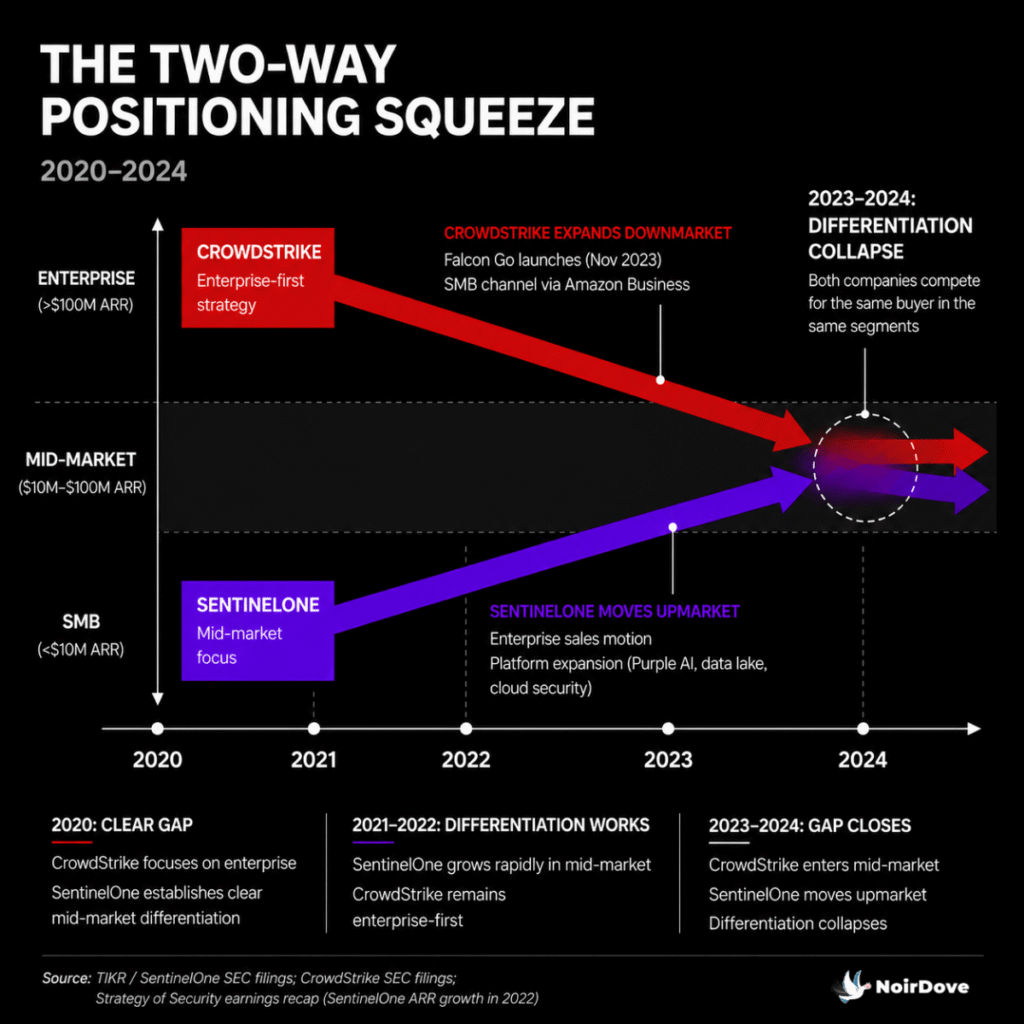
SentinelOne’s original positioning worked because it exploited a real gap: CrowdStrike was enterprise-first, priced accordingly, and left mid-market organizations underserved. That gap closed when CrowdStrike expanded downmarket with Falcon Go in 2023 and when SentinelOne moved upmarket chasing enterprise ARR. By 2024, both companies were competing for the same buyer with overlapping claims. The lesson for cybersecurity founders is not that contrarian positioning is risky. It is that positioning built on an incumbent’s current behavior assumes the incumbent will not move. In fast markets, incumbents move. The founders who survive that move are the ones who built differentiation into their architecture, not just their messaging.
In 2020, CrowdStrike Left a Specific Gap Open and SentinelOne Walked Through It
CrowdStrike in 2020 was an enterprise company with enterprise pricing. Falcon was cloud-native, category-defining, and expensive. The sales motion required dedicated IT teams, multi-month procurement cycles, and the kind of budget authority that mid-market companies with 500 to 2,000 employees rarely had. CrowdStrike knew this and did not initially treat it as a problem. Its land-and-expand model was built around large accounts, high contract values, and the Falcon platform’s ability to add modules over time.
SentinelOne was founded in 2013, two years after CrowdStrike, and identified the structural opening immediately. SentinelOne grew from $46 million in revenue in fiscal 2020 by going directly at organizations CrowdStrike was not prioritizing: mid-market security teams that wanted cloud-native EDR but could not justify Falcon’s price point or procurement complexity.
The positioning was clear and specific. Not “better than CrowdStrike” in an abstract sense; that would have been impossible to prove and easy to dismiss. The argument was more surgical: the same detection quality, autonomous response rather than analyst-dependent triage, and a price structure that mid-market buyers could actually get approved. SentinelOne served 4,700 customers at the end of Q1 FY2022, including 37 Fortune 500 companies, with its $100k+ ARR customer count up 127% year over year. The mid-market was real. The gap was real. The positioning mapped directly onto both.
CrowdStrike Moved Downmarket and the Differentiation Collapsed in Under 24 Months
The problem with positioning built on a competitor’s current behavior is that competitors are permitted to change their behavior.
CrowdStrike had two motivations to expand downmarket. First, the SMB segment was growing in security spend, and Falcon Go gave the company a path into it with a simplified tier that required no dedicated IT team to deploy. CrowdStrike launched Falcon Go on Amazon Business in November 2023, explicitly framing it as bringing “next-generation cybersecurity to the masses” and citing a strategic channel for reaching millions of SMB buyers. Second, and more consequential: CrowdStrike hired SentinelOne’s CMO and chief product officer in January 2023, two people described as “key architects of SentinelOne’s go-to-market and product strategy.” The new CrowdStrike chief business officer was tasked with SMB market share expansion. SentinelOne had handed its competitor a detailed map of exactly how it had grown.
The price gap that made SentinelOne’s positioning work became structural friction once Falcon Go existed. A mid-market buyer evaluating endpoint security in 2024 could get CrowdStrike at the SMB tier, maintain the brand credibility of the category leader, and avoid onboarding a lesser-known vendor. The “same capabilities, lower price” argument required the price to stay lower. Once Falcon Go closed that distance, the argument required rebuilding from a different premise.
SentinelOne’s growth rate reflected the shift. Revenue growth decelerated significantly in fiscal 2024, with ARR and larger customer growth both cooling alongside a declining net revenue retention rate. The mid-market wedge had worked. It had also expired.
SentinelOne Moved Upmarket at the Same Time, Which Removed the Other Half of the Wedge
The collapse of the positioning was not one-directional. While CrowdStrike was moving down, SentinelOne was moving up.
This is the part that gets missed in post-mortems about competitive positioning shifts. SentinelOne was not a passive victim of CrowdStrike’s expansion. Its own strategic choices accelerated the differentiation collapse. Enterprise ARR is more valuable than mid-market ARR. The metrics that matter for SentinelOne’s market cap average contract value, logo quality, net revenue retention- all improve when you sell up into the enterprise. So SentinelOne chased enterprise accounts, hired an enterprise sales motion, and positioned Singularity as a platform for security operations at scale.
By Q2 2024, ARR grew 32% year over year to $806 million, and new product offerings including Purple AI, data lake, and cloud solutions were contributing over a third of bookings. The product mix had shifted from a focused endpoint play to a platform story. SentinelOne moved from “better mid-market endpoint alternative” to “AI-powered security operations platform.” The first message had a clear comparison point. The second message competed directly with CrowdStrike’s Falcon, Palo Alto’s Cortex, and Microsoft’s Sentinel, all of which had larger installed bases and more enterprise references.
By the time both moves had played out, CrowdStrike was in SentinelOne’s mid-market, and SentinelOne was in CrowdStrike’s enterprise. The differentiation had collapsed on both ends simultaneously.
The Broader Pattern: Positioning Built on Competitor Behavior Has an Expiration Date
This is not a SentinelOne-specific story. It is the pattern that runs through every contrarian positioning that works until it does not.
Competitive positioning built on “the leader does not serve this segment” has one structural dependency: the leader must continue not serving that segment. In slow markets, incumbents are slow to move. In fast markets, incumbents move faster than most founders model. Cybersecurity is a fast market. The incentive to capture a growing segment is significant. The ability to deploy capital into a new pricing tier or a new channel is available to any company with Falcon’s ARR.
What SentinelOne built between 2020 and 2022 was not wrong. It was correct for the window it occupied. The error is one of planning horizon, not strategy. Positioning that exploits a current gap must answer the question: what happens to our differentiation when the gap closes? SentinelOne’s answer in 2023 and 2024 was a pivot to autonomous AI and Purple AI, announced at RSAC 2023 and built out through 2024 and 2025. At OneCon 2024, SentinelOne unveiled Singularity Hyperautomation, AI SIEM, and advanced Purple AI capabilities explicitly positioned around the autonomous SOC vision. By April 2025, SentinelOne was presenting Purple AI Athena at RSAC as the first agentic AI capabilities to mirror the deep security reasoning of advanced SOC analysts.
That is a real repositioning. It is also one that every other major security vendor is racing toward simultaneously. CrowdStrike has Charlotte AI. Palo Alto has AI Access Security. Microsoft has Security Copilot. The question SentinelOne now has to answer is the same question it faced in 2020, just in a different category: can we get there first and stay there long enough to build a durable position before the leaders follow?
What Works Instead: Differentiation That Compounds, Not Gets Commoditized
There is a useful distinction between positioning that is temporarily correct and positioning that is structurally durable. The difference is where the differentiation lives.
SentinelOne’s 2020 positioning lived in the market gap, not in the product. CrowdStrike was not in the mid-market. SentinelOne was. That gap was real, but it was a feature of the competitive landscape, not a feature of the product. Features of the competitive landscape change when competitors move. Features of the product change only when the product changes.
The founders who survive competitive convergence build differentiation into their architecture. Wiz did this: the Security Graph and agentless deployment were architectural choices that Prisma Cloud could not replicate without rebuilding from its acquisition-assembled foundation. Abnormal Security did this: its behavioral baseline model required years of email data that a new entrant or a fast-following incumbent could not replicate quickly. Both companies built positions that required the competitor to restructure their product to copy, not just their pricing.
SentinelOne’s autonomous remediation capability, running on-device without connectivity, is architecturally differentiated. Ease of deployment and autonomous remediation are consistently cited as decisive factors in enterprise bake-offs where SentinelOne wins. That is positioning built on what the product actually does differently, not on where the competitor currently is not. The mid-market price argument was correct but temporary. The autonomous response architecture was the thing worth defending.
The founders who build durable positioning ask one question before launching: if the market leader decides this segment matters to them in 18 months, what remains of our differentiation? If the honest answer is “not much,” the positioning is a window, not a moat.
FAQs
SentinelOne’s revenue still grew significantly even after the mid-market positioning weakened. Does that mean the strategy was actually durable?
Revenue growth is a lagging indicator for positioning durability. SentinelOne grew through the repositioning period because it had a large installed base renewing, an expanding product suite generating upsell, and a 2024 CrowdStrike outage that sent some enterprise buyers looking for alternatives. Its ARR grew 32% year over year to $806 million in Q2 2024, but the composition of that growth had shifted significantly toward new products like Purple AI and cloud security rather than the core endpoint mid-market motion. Revenue growth can continue after a positioning has been commoditized, especially when the installed base is large. What it cannot do is tell you whether the next cohort of customers is choosing you for a differentiated reason or a commoditized one.
CrowdStrike launched Falcon Go in 2023, but it has a 100-device cap and limited EDR. Is that really closing the gap with SentinelOne?
Falcon Go’s 100-device cap and the absence of full EDR and behavioral investigation capability mean the overlap with SentinelOne’s mid-market play is not complete. The more significant mechanism was the perception shift, not the feature parity. A mid-market CISO evaluating endpoint security in 2024 could tell their board they were running CrowdStrike. That credibility claim was not available in 2020. The gap closed at the brand level before it closed at the feature level, and in enterprise security, brand-level credibility affects evaluation shortlists before anyone looks at feature matrices.
Every major security vendor is now positioning around AI and autonomous SOC. Does SentinelOne’s Purple AI repositioning face the same shelf-life problem the mid-market positioning did?
Yes, with one important difference. The mid-market positioning was based on where CrowdStrike was not operating. The autonomous AI positioning is based on what SentinelOne has built inside the product. Purple AI’s agentic investigation capability, opened to all customers in June 2026, autonomously detects, investigates, verifies, and responds to threats without human dependencies. That is architecturally embedded, not just a messaging layer over existing features. The shelf life is longer when the differentiation is inside the product rather than inside a market gap. Whether it is long enough to establish a durable category position before Microsoft Security Copilot or CrowdStrike Charlotte AI reaches equivalent capability is the open question.
What should a security startup founder take from this when building their own positioning?
Build the 18-month scenario before you commit to the positioning. Not “where is the leader not operating today” but “where will the leader be operating in 18 months, and what remains of our position if they get there?” The answer should be something architectural, not something geographic. SentinelOne’s autonomous remediation architecture was the right answer. Its mid-market price positioning was the wrong one to anchor on. The architecture was harder to follow. The price gap was easy to close. Build the positioning around the thing that requires restructuring to replicate, not around the thing that requires a pricing decision.
Sources Referenced
- SentinelOne, fiscal 2021 earnings, January 2021 (revenue $93.1M, NRR 117%, 4,700 customers)
- Sycamore Capital / Finviz, SentinelOne Bull Case Theory, March 2025 (ARR $67M in 2020 to $1B+ by 2025)
- The Motley Fool, SentinelOne vs CrowdStrike comparison, July 2021 (Q1 FY2022 customer metrics, $100k+ ARR cohort)
- BusinessWire / CrowdStrike press release, January 17, 2023 (SentinelOne CMO and CPO join CrowdStrike, SMB mandate)
- Forbes / Tony Bradley, CrowdStrike Falcon Go launch, November 15, 2023 (SMB tier, Amazon Business channel)
- SiliconAngle, CrowdStrike Falcon Go on Amazon Business, November 22, 2023 (strategic SMB channel rationale)
- The Globe and Mail / Motley Fool, SentinelOne FY2024 earnings recap (growth deceleration, ARR cooldown)
- Torrent Capital, SentinelOne Q2 FY2025 earnings analysis, November 2024 (ARR $806M, 32% YoY, Purple AI contribution)
- Pestel Analysis / MatrixBCG, SentinelOne competitive landscape, 2025 (market share 9.47% vs CrowdStrike 20.46%)
- TIKR.com, SentinelOne vs CrowdStrike long-term analysis, April 2026 (revenue comparison, operating margins)
- MatrixBCG, SentinelOne competitive positioning, May 2026 (autonomous remediation win rates, ease of deployment)
- BusinessWire / SentinelOne, OneCon 2024 announcement, October 16, 2024 (Singularity Hyperautomation, AI SIEM, Purple AI)
- SentinelOne press release, RSAC 2025, April 29, 2025 (Purple AI Athena, agentic investigation capabilities)
- SentinelOne press release, June 17, 2026 (Purple AI Agentic Investigation opened to all customers)
- Valydex, CrowdStrike Falcon Go review, May 2026 (100-device cap, limited EDR at SMB tier)
Talk to Noir Dove
If your security product’s positioning is built on a gap the market leader has not closed yet, that gap is a timeline, not a strategy. Noir Dove diagnoses whether your commercial differentiation lives in your architecture or in your competitor’s current behavior, before the next product cycle forces the question. Book a Clarity Call. One conversation before you set the messaging for the next 18 months.