Disclaimer: This is a hypothetical thought experiment, not a commentary on CrowdStrike’s current strategy or performance. It uses CrowdStrike as a lens to explore how cybersecurity GTM and buyer behavior have changed.
Imagine CrowdStrike as it is today: It’s a startup launching as we speak. There’s no brand recognition or a decade of business relationships. There’s no Falcon platform that analysts trust and rely on. Only the good stuff: the team, the threat intelligence, and the product fighting to be noticed among the impossible crush of competition.
What’s the truth that unsettles most startup founders?
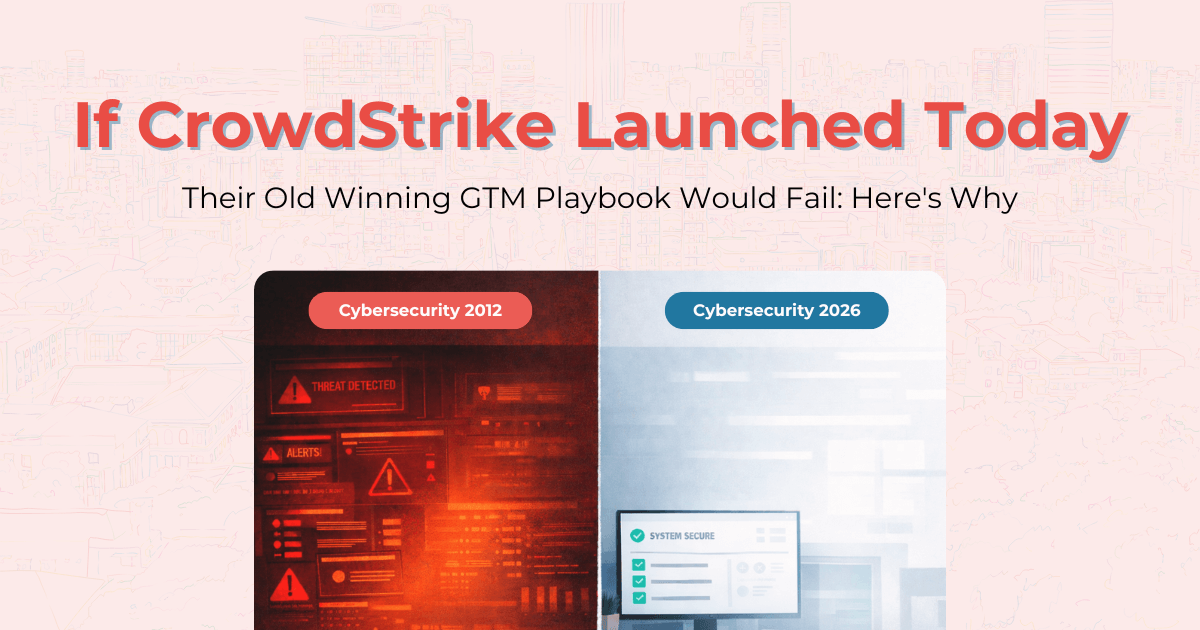
The “playbook” that made CrowdStrike so successful in 2012 would hurt them in 2026. Not because the product won’t work, but because everything about how buyers assess, trust, and buy security software has changed.
What Made CrowdStrike’s Initial GTM a Success
CrowdStrike’s entry into the market during the early 2010s found the endpoint security industry in a state of stagnation. The traditional antivirus companies were still delivering signature-based detection solutions and hoping their customers wouldn’t ask too many questions about advanced threats.
CrowdStrike didn’t position themselves as “better antivirus.” They actually shifted the whole conversation. The essence of what they said was: Breaches have been occurring, and you’re not even seeing them. Sure, they had superior technology with cloud native and behavior detection, but it’s all about the narrative. They shifted the whole conversation from prevention to visibility and response.
Their early GTM was reflective of this. Sales teams were led by founders, and transactions resembled consulting deals rather than software deals. Discussions were like incident responses because that was what customers needed. They trusted CrowdStrike because they spoke like people in their industry who knew the space, and not like people reading from slides.
It worked this way because it involved true learning on the part of the buyers. The gap in sophistication stood out. The fear level was high and productive. Anyone able to articulate advanced attack patterns would gain immediate credibility.
Such an environment does not exist anymore.
The Market Reality for a 2026 CrowdStrike Launch
If CrowdStrike founded its company today, it wouldn’t be disrupting complacent anti virus companies. It would be entering an extremely competitive security market in which all security vendors tout the same features, and consumers have heard all the same pitches three times before.
Everyone promises AI-driven detection. Every endpoint product promises behavioral analysis. Every talk presentation addresses platform consolidation. And most likely, most of these vendors have underdelivered, which leaves buyers disillusioned and, by default, skeptical.
The challenge is reversed. It’s not that buyers can’t detect threats, now they can’t distinguish what’s truly important. Security teams are struggling to stay afloat in a sea of alerts. CISO’s are under relentless pressure to simplify and reduce expenses. SOC analysts are working themselves to the point of exhaustion without progress on prioritization.
This revolutionizes the GTM equation entirely. In 2012 buyers deferred to the vendors because they hadn’t yet learned; in 2026 buyers dispute everything because they’ve been hurt. Instead of viewing circumstances as complicated because they contain a lot of moving parts, many vendors and many types of cloud services , buyers in the future will recognize that they are complicated because they lack clarity.
The Paradox: CrowdStrike’s DNA Would Be Its Biggest Liability
Here is the key thing that most founders of a security company miss when analyzing the success of CrowdStrike:
CrowdStrike’s founding strength was that it leveraged deep technical expertise with high-touch, large-enterprise sales. In that same DNA starting now, there would be an inherent risk that there would be a bias towards overengineering features, overexplaining capabilities, and overhyped technical complexity to establish differences.
This instinct would hinder growth in a modern market.
What modern buyers reward is not depth first, but restraint. What they are looking for is sellers who decrease their decision fatigue, not sellers who increase it. What they are looking for are simplified stories that align with business outcomes, not technical stories that have to be ‘translated’ into business-speak.
A CrowdStrike in the year 2026 would have to overcome its own strengths in order to win.
How Positioning Must Change
As noted above, positioning plays Crowdstrike began with a more tech-savvy, highly sophisticated view of threat detection. This resonated through the noise in the space, which hadn’t yet awakened to new threats.
In today’s market, this positioning has become table stakes. It weaves its way through all of the competitors’ messages.
A more contemporary CrowdStrike would not focus on being “most advanced endpoint security.” Rather, they would need to focus on operational certainty. The true threat isn’t malware or zero-days. It’s decision paralysis and alert fatigue.
The positioning would be moved away from endpoint protection, which is a purely security issue, to something more uncomfortable and honest: a system that will tell the security team what needs to be dealt with now, what a week from now, and what needs to be ignored altogether.
The value proposition: less decision-making and less detection. More confidence in decisionmaking and less need for data points.
This paradigm applies to buyers as they perceive their employment situation and not as technology vendors wish to speak about technology.
Messaging Shift: From Fear to Relief
Early CrowdStrike messaging was all about fear. “Advanced persistent threats, nation-state groups, attacks that use zero-days that conventional defenses can’t stop.” Of course, fear was still a viable discovery mechanism because customers were still understanding their risk exposure.
Nowadays, fear messaging does little to mobilize people. Buyers are already fearful. Threat fatigue is a real phenomenon. What they crave is some respite from the pressure and noise.
What’s missing from security messaging today?
Modern messaging would need to focus on workload reduction. Fewer alerts that matter more. Faster investigation cycles with clearer outcomes. Cleaner handoffs between SOC analysts and leadership that don’t require re-explaining technical details.
The strongest messages would sound almost boring compared to typical security marketing:
“We assist your team in ending the pursuit of false positives and concentrate on real threats.”
“We reduced the time spent on investigation by half so that your analysts can go home on time.”
“Incident response, we make decisions clear, rather than exhausting.”
That’s what earns trust in 2026. Not superiority, at least, and certainly not technological.
GTM Motion: The Multi-Track Approach
Early CrowdStrike could initiate a sales-driven motion right from the first day. Business buyers were ready to get involved in the product early in the life cycle and endure lengthy sales cycles and purchase vision before the need for complete proof.
It would not work now. Consumers would be too skeptical and have other ties developed already.
A contemporary GTM would have to proceed on three tracks simultaneously:
Marketing leads with strong points of view. Not everything gated behind forms. Not generic blog content about threat trends. Clear, opinionated takes on what’s broken in security buying itself, the vendor bloat, the alert fatigue, the misalignment between tools and actual team capacity.
Product carries more of the trust burden. Not full product-led growth, but controlled proof mechanisms. Sandbox environments that show actual value. Read-only integrations that surface insights without requiring migration. Evidence before commitment, not sales promises followed by proof-of-concept theater.
Sales orchestrates expansion, not evangelism. Smaller initial deals with tightly scoped outcomes. Clear value demonstration that maps to specific pain points. A defined expansion path to broader platform conversations only after proving operational value.
Trust has to be built prior to conversion, not during the procurement process.
Understanding How Buyer Behavior Has Changed
The shift in buyer psychology is more significant than any product innovation:
Then: Buyers wanted to learn from experts and thought leaders.
Now: Buyers want predictable outcomes with minimal risk.
Then: CISOs wanted vision decks about the future of security.
Now: CISOs want board-ready narratives about risk reduction and ROI.
Then: SOC teams tolerated noisy tools if they caught sophisticated threats.
Now: SOC teams actively resist anything that adds operational friction.
A modern CrowdStrike would need one product but three tightly aligned narratives. One message for executive leadership focused on business risk. One for security operators focused on daily workflow. One for IT focused on integration and management overhead.
Any mismatch between these narratives would create friction and slow deals. Every stakeholder needs to see clear value in their terms, not translated from a single technical story.
A Concrete Scenario: The First Six Months
Imagine a 20-person CrowdStrike launching today with a product-market fit hypothesis to test.
They wouldn’t start by pitching Fortune 100 CISOs on platform vision. They’d target mid-market security teams drowning in tool sprawl and alert fatigue. The initial buyer would be a SOC manager or security operations lead, not a CISO making strategic platform decisions.
The wedge wouldn’t be “comprehensive security platform.” It would be one narrow, painful problem: decision confidence during active investigations. Not detecting more threats, helping analysts quickly determine which alerts actually matter and what action to take.
The first six months would obsessively focus on proving one outcome: Fewer alerts that analysts actually action. Faster investigation cycles from detection to resolution. Measurable reduction in analyst burnout and overtime.
Only after demonstrating that operational value would the conversation expand to broader platform capabilities and CISO-level strategic positioning.
This isn’t weaker ambition, it’s sharper sequencing. Prove operational value first, expand strategic positioning second.
What Hasn’t Changed
Some fundamentals remain constant across market cycles:
Trust still compounds slowly through reference customers and word-of-mouth. One strong internal champion who genuinely loves your product still beats broad stakeholder consensus built on compromise. Reference customers from respected organizations still matter disproportionately for credibility.
The difference is timing. In 2012, you could promise trust and build it during the sales cycle. In 2026, you need to demonstrate it before asking for serious evaluation time.
Where Founders Go Wrong Copying CrowdStrike
Many security founders study CrowdStrike’s success and copy the wrong elements at the wrong time.
They talk about category creation before proving discrete value. They sell platform vision to CISOs before winning operational trust with security teams. They use expansive language about transforming security operations without earning small, specific wins first.
Those moves worked in CrowdStrike’s market context. Today, they create drag and skepticism.
The lesson isn’t to aim smaller, it’s to aim clearer. Solve one painful problem exceptionally well, prove that value clearly, then expand the conversation.
Then vs. Now: A Direct GTM Comparison
| Dimension | Then | Today |
|---|---|---|
| Core Value Proposition | Advanced threat detection and response | Decision clarity and operational confidence |
| Primary Initial Buyer | CISO, incident response leaders | SOC managers first, CISO expansion |
| Buyer Psychology | Fear-driven, discovery phase | Skeptical, fatigued, risk-averse |
| Messaging Anchor | “You are already breached and blind” | “We reduce chaos and cognitive load” |
| GTM Motion | Founder-led, sales-heavy | Marketing builds trust, product proves value, sales expands |
| Content Strategy | Threat research, breach narratives | POVs on tool fatigue, operational simplification |
| Sales Cycle | Long, vision-heavy deals | Shorter initial deals with clear expansion paths |
| Competitive Edge | Technical superiority, cloud architecture | Simplicity and speed to clarity |
| Category Framing | EDR pioneer | Operational control layer for endpoint risk |
The Real Lesson for Founders and Product Marketers
If CrowdStrike launched today, it wouldn’t look like CrowdStrike. And that’s exactly the point.
The next breakout security company won’t win by detecting more threats or claiming more sophisticated AI. It will win by helping security teams make fewer decisions, faster, with higher confidence in outcomes.
In a market drowning in threat intelligence and detection capabilities, clarity is the last sustainable competitive advantage. The winners will be the vendors who reduce cognitive load instead of adding to it.
If you’re navigating these GTM challenges in your own cybersecurity company, we’ve built frameworks and solutions specifically for this shifted landscape. Check out our cybersecurity GTM solutions to see how we help security companies build positioning, messaging, and go-to-market strategies that actually work in 2026.