If your B2B company is between $1M and $10M ARR and your website is not booking demos, the issue is rarely traffic. It is structure.
Most B2B sites at this stage read like brochures. A homepage that lists features. A nav bar copied from a template. A “Talk to Sales” button in the top right that nobody clicks. Buyers land, scroll for eleven seconds, and leave.
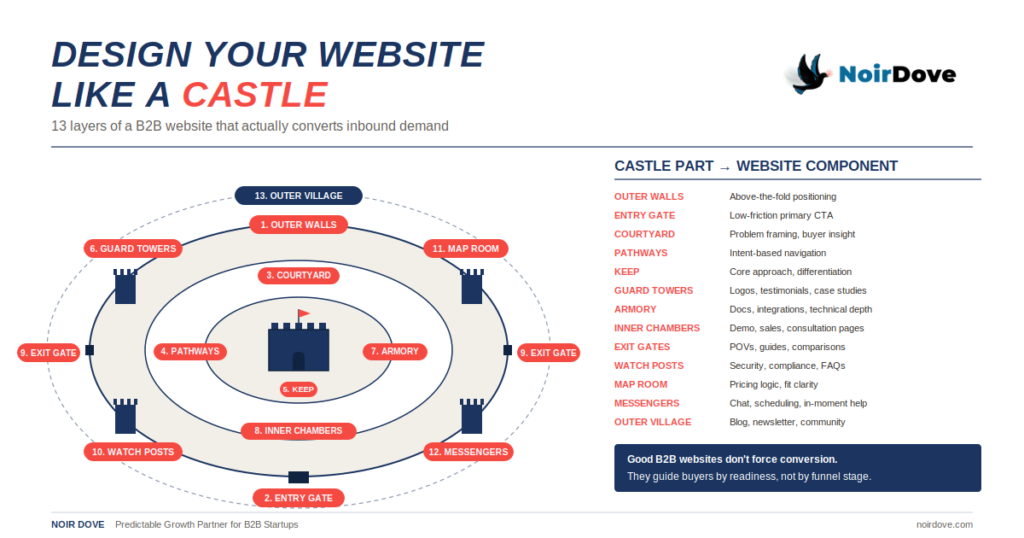
A castle works better as a mental model. It is a layered system designed to welcome the right people, route them by intent, and reduce risk at every step. Here is what that looks like on a website.
1. Outer Walls
The fold has to answer three things before a buyer scrolls: who you serve, what you fix, why it matters now. “AI-powered platform for modern teams” fails all three. “Compliance automation for SOC 2 audits, built for 50 to 500 person SaaS companies” passes.
2. Entry Gate
A 30-second visitor is not ready to talk to your AE. Replace the lone “Book a Demo” button with a softer first step. Watch a 4-minute product tour. See a teardown. Read the framework. Notion does this well: the primary CTA is “Get Notion free,” not “Contact sales.”
3. Courtyard
Before you pitch, prove you understand the buyer’s job. A CISO buying an EDR tool already knows endpoints get compromised. Skip that. Name the specific frustration: alert fatigue at 3am, three quarters of tickets being false positives, the analyst who quit because of it. That is the moment they trust you to keep reading.
4. Pathways
Most B2B navs are organized by what the company sells. They should be organized by why someone arrived. A founder evaluating a category, a director comparing two finalists, and a procurement lead doing due diligence are not looking for the same page. Stripe routes these as Developers, Businesses, and Enterprise. Three doors, three journeys.
5. The Keep
This is where you explain how you actually solve the problem and why your approach beats the obvious alternative. Not a feature grid. The thinking. If your competitor uses rules-based detection and you use behavioral models, say that and explain the trade-off. Buyers who reach the keep are comparing you to two or three other vendors. Make it easy.
6. Guard Towers
Logos without context are wallpaper. A logo wall that reads “Trusted by Acme, Globex, Initech” tells me nothing. A case study that says “Ramp cut their close from 8 days to 2” tells me everything. One specific outcome with a named customer beats fifteen anonymous quotes.
7. Armory
The technical buyer needs depth. API docs, integration list, architecture diagrams, data residency options, SSO support. This content does not belong on the homepage, but it must exist and be linkable. When a champion forwards your site to their security team, the security team is looking for the armory. If it is missing, the deal stalls in review.
8. Inner Chambers
The demo request page. The sales contact form. The pricing call booker. These pages should do one thing. Strip the global nav, kill the footer links, remove the chat widget. A buyer who reached this page already decided. Do not give them a reason to wander off.
9. Exit Gates
Most visitors are not buying this quarter. That is not a failure. Give them something to leave with: a teardown of how three companies solved the same problem, a comparison guide, a benchmark report. They come back in six months when budget unlocks, because you respected their timing instead of chasing them with a 14-email nurture.
10. Watch Posts
Trust pages do not win deals. They prevent losing them. Security page, compliance certifications (SOC 2, ISO 27001, HIPAA), DPA template, subprocessor list, status page. None of this drives conversions on its own. All of it gets requested in procurement review. Missing one of them can add six weeks to a deal cycle.
11. Map Room
You do not have to publish exact prices. You do have to help buyers self-qualify. A 12-person seed startup should know within 30 seconds whether your $50k floor disqualifies them. Pricing pages that hide everything behind “Contact Sales” waste your AE’s time and the buyer’s time in equal measure.
12. Messengers
Live chat is useful when it answers one specific question fast. It is useless when it pops up after eight seconds with “Hi, how can I help you today?” Replace the always-on bot with intent triggers: a chat prompt on the pricing page, a scheduling widget on the demo page, nothing on the blog.
13. Outer Village
The blog, newsletter, podcast appearances, founder posts on LinkedIn, community presence. The outer village is what builds memory over 6 to 18 months. It is also the reason someone types your name into Google instead of arriving through a paid ad. Treat it as the longest-payback asset you own, because it is.
What this changes
A buyer at the outer walls needs clarity. A buyer at the guard towers needs proof. A buyer at the inner chambers needs a clean path. Treating all three the same is what makes inbound feel broken.
Walk your own site like a stranger. Start at the homepage, try to reach the demo form, and count how many decisions you forced on the way. If the answer is more than five, the castle has too many walls and not enough gates.
If your B2B website is not converting the way it should, book a growth strategy call with Noir Dove.