India trains more doctors every year than any country on earth. It still has fewer working physicians per person than the United States, and the ones it has are concentrated in a narrow band of cities that most of the country’s population doesn’t live in. That’s not a supply problem. It’s an address problem, and founders who read “doctor shortage” as a market opportunity keep building GTM motion for a doctor who doesn’t exist in the volume, location, or income bracket they assumed.
Summary
- India’s official doctor-population ratio is 1:834, better than the WHO’s 1:1000 benchmark, per a 2022 statement to the Lok Sabha. That number counts registered doctors. Internationally comparable practicing-physician density puts India closer to 0.9 per 1,000, against 2.6 per 1,000 in the US.
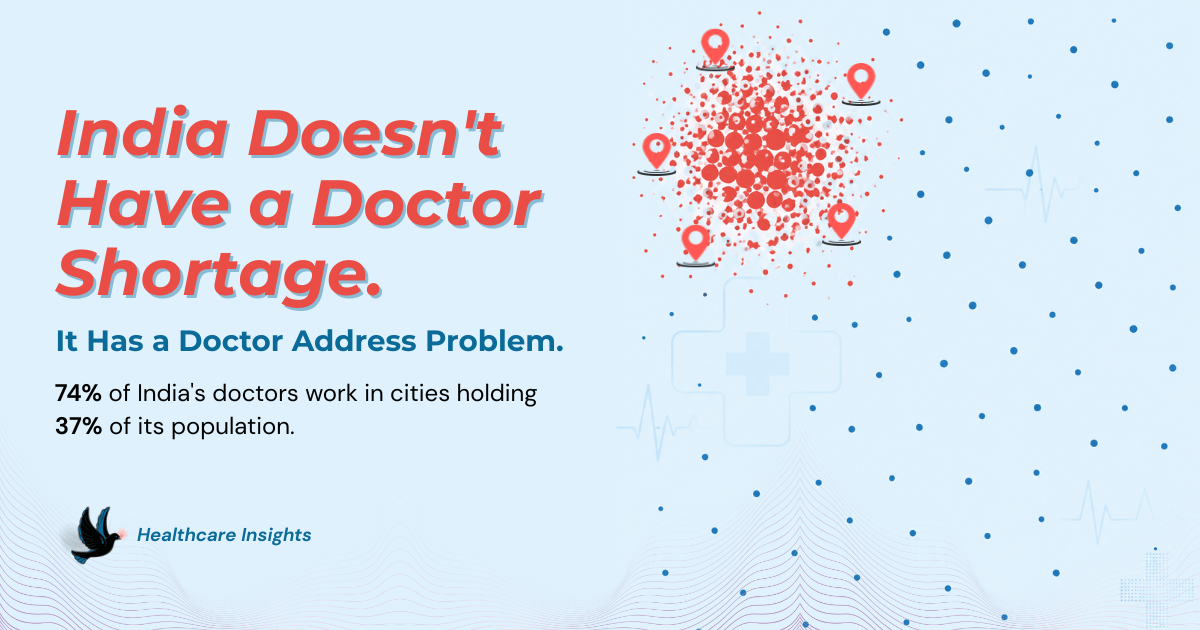
- Roughly 74% of India’s doctors work in urban areas, per 2024 state-level analysis, while 63% of Indians live in rural areas, per World Bank data.
- Rural Community Health Centres are short 79.9% of their sanctioned specialist posts, per the Ministry of Health and Family Welfare’s Health Dynamics of India report, released September 2024. Madhya Pradesh alone is short 94%.
- A doctor in a metro private hospital can earn ₹70,000 to ₹3,00,000 a month. A doctor at a rural government facility starts around ₹25,000. The buyer a founder is selling to changes completely depending on which doctor they mean.
TLDR
India isn’t short on doctors in the way founders assume. It’s short on doctors in specific places, and long on doctors in a handful of cities. 74% of India’s doctors work in urban areas that hold 37% of the population. Rural Community Health Centres are missing 79.9% of their sanctioned specialist posts (Health Dynamics of India, September 2024). A GTM strategy built on “there aren’t enough doctors, so ours will get adopted fast” is solving the wrong equation. The real constraint is concentration, income, and who the doctor already answers to, not headcount.
India Doesn’t Have a Doctor Shortage. It Has a Doctor Address Problem.
Here’s the number founders build pitch decks around: India has roughly one practicing doctor for every 1,000 people, against 2.6 per 1,000 in the US, per OECD-comparable data. Read as a national average, it looks like whitespace. Build a telehealth product, a diagnostic tool, a clinical decision aid, and there should be a queue of underserved doctors ready to adopt it.
The Indian government’s own number tells a different story depending on how you count. In December 2022, the Ministry of Health and Family Welfare told the Lok Sabha the doctor-population ratio was 1:834, ahead of the WHO benchmark, based on 13.08 lakh registered allopathic doctors and an assumption that 80% of them are actively practicing. Both numbers are technically correct. Neither tells a founder where the doctors actually are, which is the only number that matters for a GTM plan.
They are not evenly spread. They are stacked in Delhi, Mumbai, Bangalore, Chennai, and a handful of other metros, serving a fraction of the country’s population at a density that would look normal in a mid-tier European city. The rest of India, the 63% living in villages and small towns per World Bank data, is left with what’s left over. That’s not a shortage statistic. It’s a distribution map, and most founders never look at it before they build.
Selling to an Indian Doctor Is Selling to a Solo Entrepreneur, Not a Hospital System
A founder who has sold into US healthcare assumes a doctor sits inside a system. There’s a hospital IT department, a procurement process, a compliance officer, a group practice with a shared EMR and a shared decision on which vendor gets access. None of that infrastructure exists for the majority of Indian doctors a health-tech founder will try to reach.
Most Indian physicians outside the large corporate hospital chains operate as independent practitioners or small partnerships. They run their own clinic, manage their own patient records, often on paper, and make every purchasing decision alone, on their own time, between patients. A doctor in a tier-2 city clinic isn’t evaluating your product against a competitor’s RFP. They’re deciding whether to open the app between the seventh and eighth patient of a twelve-hour day, and whether it will make that day faster or slower.
This changes who you’re actually selling to. You are not selling to a hospital system. You’re selling to an entrepreneur who has to personally learn the tool, personally see the value inside two or three uses, and personally decide it’s worth recommending to the two other doctors he trained with. Practo learned this early. It didn’t start by selling hospital-wide software. It started as a doctor discovery and appointment tool built around individual practitioners in Bangalore, because that’s the actual unit of adoption in the Indian market: one doctor, one decision, no procurement layer to route around.
Doctors in this position are also overbooked and structurally skeptical. A physician seeing 60 to 80 patients a day in a government OPD, or running a solo clinic with no support staff, has already had a decade of vendors promise to save them time and instead cost them time. The skepticism isn’t cultural resistance to technology. It’s a rational response to a track record. Any GTM plan that assumes eager adoption because “doctors are overworked and need help” is assuming a level of trust that has to be earned individually, clinic by clinic, before it can be assumed at scale.
The Real Number Isn’t 1,000 Patients Per Doctor. It’s Which 1,000.
The word “shortage” implies the problem is headcount. The actual problem is concentration, and the two require completely different solutions.
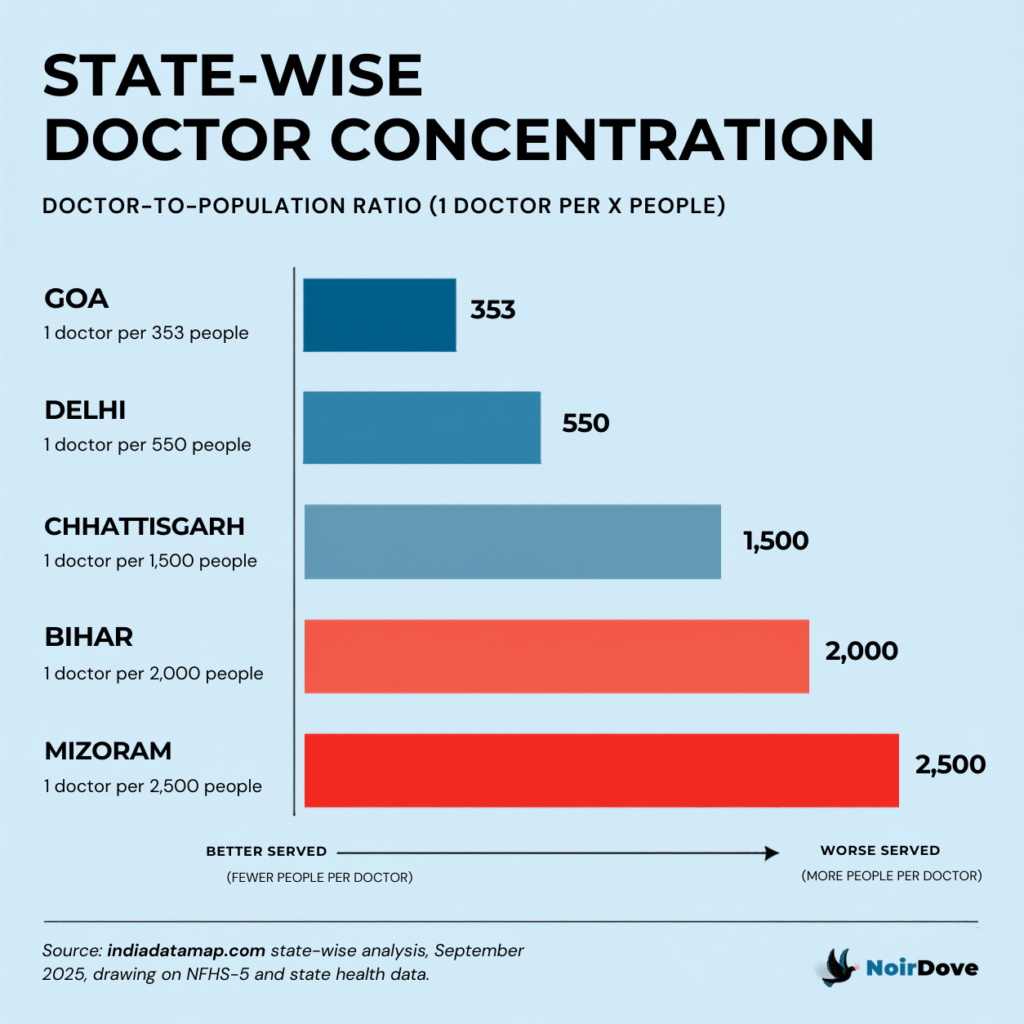
74% of India’s doctors work in urban settings, according to 2024 state-level analysis of NMC and health ministry data. In state after state, the pattern repeats. Delhi has roughly one doctor for every 550 people. Goa, with its private hospital density, sits around 1:353. Bihar sits near 1:2,000. Chhattisgarh is close behind at 1:1,500. Mizoram, with a single medical college in the entire state, is at roughly 1:2,500.
Zoom into the government’s own Rural Health Statistics and the concentration problem gets sharper. Community Health Centres, the secondary-care backbone for rural India, are short 79.9% of their sanctioned specialist posts as of the government’s Health Dynamics of India report, published September 2024. Only 4,413 specialist positions were filled against 21,964 sanctioned. Madhya Pradesh is short 94% of its specialist posts. Bihar is short 80.9%. Rajasthan, 80.3%. Uttar Pradesh, 74.4%. These aren’t emerging gaps. The CHC specialist vacancy rate has grown from 45% in 2005 to roughly 80% today, meaning the concentration problem has gotten worse over two decades of medical college expansion, not better.
This is the part founders miss. India isn’t failing to produce doctors. It’s failing to distribute them, and no amount of new supply fixes a distribution problem, because new graduates make the same rational choice their predecessors did: practice where the patients can pay and the infrastructure exists to support a career, which means the city, not the village.
Why Direct-to-Doctor GTM Stops Working the Moment You Leave the Metro
If concentration, not scarcity, is the real shape of the problem, the GTM implications flip. A founder can’t build a plan that assumes doctor adoption scales evenly across the country, because the buyer isn’t evenly distributed and doesn’t share one set of economics.
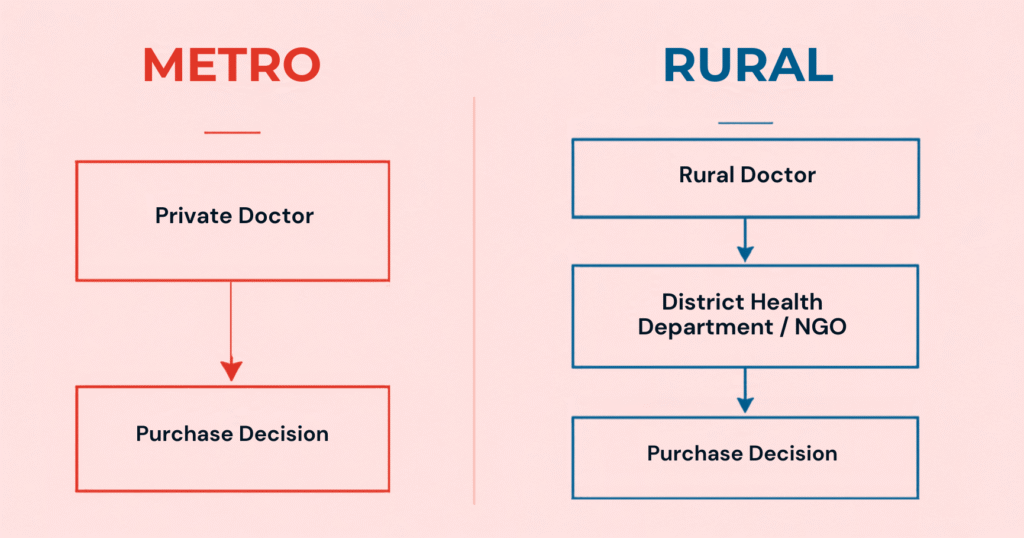
In the metros, you’re selling to a doctor who might earn ₹70,000 to ₹3,00,000 a month in private practice, has some administrative support, and has a plausible path to paying for software if it demonstrably saves time or adds revenue. Direct-to-doctor GTM can work here, the way it worked for Practo in its early years, because the buyer has both the authority and the economics to say yes.
Move past the top 8 to 10 cities and that buyer largely disappears. A government doctor at a rural CHC starts around ₹25,000 a month, has no discretionary budget, and isn’t the purchasing authority even if they wanted your product. The purchasing authority is the state health department, the district administration, or the NGO running the facility. Selling to the doctor here doesn’t fail because the doctor is uninterested. It fails because the doctor was never the buyer in that geography to begin with.
This is why the healthtech companies that have actually reached rural India didn’t sell direct-to-doctor at all. eSanjeevani, the government’s own telemedicine platform, runs on a hub-and-spoke model connecting roughly 155,000 health and wellness centres to specialists in cities, funded and mandated by the state, not sold clinic by clinic. Neurosynaptic Communications built its ReMeDi telemedicine devices around government primary health centre deployments rather than individual physician sales. iKure Techsoft built its rural health model around ASHA workers and NGO partnerships, treating the community health worker, not the doctor, as the frontline user. None of these are direct-to-doctor plays. They’re government-and-NGO-channel plays, sold to an institutional buyer with a mandate and a budget line, because that’s who actually has purchasing power once you leave the metro.
A founder who has only modeled the market as “1,000 patients per doctor, multiplied by the number of doctors” has built a TAM that assumes every doctor is the same buyer with the same budget. They aren’t. The metro doctor and the rural CHC doctor are two different markets requiring two different sales motions, two different pricing models, and in most cases, two different buyers entirely.
Map the Doctor Before You Build the Product
Before writing a single line of GTM strategy for the Indian healthcare market, a founder needs three answers, not one TAM slide.
Where does this specific doctor practice, and what share of India’s doctor population actually sits in that geography. Who does that doctor serve, a self-pay urban patient base or a rural population dependent on government or NGO-funded care. And what does that doctor actually earn, because a ₹25,000-a-month government physician and a ₹3,00,000-a-month private specialist are not the same customer, don’t respond to the same pricing, and in many cases don’t even hold the purchasing decision.
Scarcity does not equal purchasing power. That’s the assumption that breaks the most healthcare GTM plans in India, the belief that because doctors are stretched thin, they are also empowered and funded to buy their way out of it. Some are. Most of the doctors carrying the actual shortage, the ones in Madhya Pradesh’s 94%-vacant specialist posts and Bihar’s 1:2,000 ratio, are not.
The founders who get this right don’t ask how many doctors India needs. They ask which 1,000 people their doctor actually serves, what that doctor earns, and who signs the check if it isn’t the doctor at all. That question doesn’t have one answer across India. It has as many answers as India has districts, and a GTM plan that doesn’t account for that difference was never going to scale past the first city it launched in.
FAQs
Is India’s doctor-population ratio actually better than the WHO standard, as the government claims? By registered headcount, yes. The 1:834 ratio cited to the Lok Sabha in December 2022 counts 13.08 lakh registered allopathic doctors and assumes 80% are actively practicing. That figure doesn’t account for doctors who have emigrated, retired, or hold registrations they no longer use for direct patient care, and it says nothing about where those doctors are located. Internationally comparable practicing-physician density puts India closer to 0.9 doctors per 1,000 people, well below the WHO benchmark and less than half the US rate of 2.6 per 1,000.
If direct-to-doctor GTM works in metro India, why can’t a founder just expand city by city? Because the doctor economics and purchasing authority change faster than the product does. A founder can expand from Bangalore to Mumbai to Delhi and still be selling to the same type of buyer, an independent or small-group urban practitioner with discretionary budget. The moment the expansion moves past the top 8 to 10 cities into the towns and districts where 63% of India’s population lives, the buyer becomes a government health department, a district hospital administrator, or an NGO, not the doctor. That’s a different sales cycle, different procurement, and often a different product entirely.
Do NGOs and government health programs actually pay for private health-tech products, or is this channel mostly grants and pilots? Both, depending on the program. eSanjeevani is state-funded infrastructure, not a customer relationship in the traditional sense, but its hub-and-spoke model has become a distribution layer other health-tech companies build referral and specialist-access partnerships around. State health departments and PPP-model CHC management contracts, like Madhya Pradesh’s move to hand district CHCs to private operators, represent a more direct commercial channel, but the sales cycle runs through government procurement and tender processes, not a founder’s inside sales team calling doctors.
Does this mean scarcity-based positioning (“built for India’s doctor shortage”) should be avoided entirely in Noir Dove client messaging? Not avoided, but never left unqualified. “India has a doctor shortage” is true and defensible as a macro fact. What breaks a GTM plan is treating that macro fact as if it describes a single, evenly distributed buyer. The positioning that holds up names which doctor, in which geography, at which income level, is being addressed, and builds the buying motion around that specific reality instead of the national average.
Sources Referenced
- Union Ministry of Health and Family Welfare, statement to the Lok Sabha, December 2022 (doctor-population ratio 1:834)
- Statista / OECD, cross-country physician density comparison
- The Hindu, 2024, state-level analysis of doctor distribution (74% urban concentration)
- Ministry of Health and Family Welfare, Health Dynamics of India: Infrastructure and Human Resources, released September 2024 (CHC specialist shortfall, state-level breakdown)
- indiadatamap.com, state-wise doctor-to-patient ratio analysis, drawing on NFHS-5 and state health data, September 2025
- futureMBBS, Doctor Salary in India 2025, July 2025
- NABARD, All India Rural Financial Inclusion Survey (NAFIS) 2021-22, released 2024
- World Bank, Rural population (% of total population), India, 2024 data
- Ministry of Health and Family Welfare, eSanjeevani platform data, mid-2025
Talk to Noir Dove
If your GTM plan was built on India’s doctor shortage as a single national number, it’s solving for a buyer that doesn’t exist in most of the country. Noir Dove diagnoses where the commercial system breaks before you scale a plan built on the wrong map. Book a Clarity Call. One conversation, before the next sales hire gets sent into a market that was never modeled correctly.