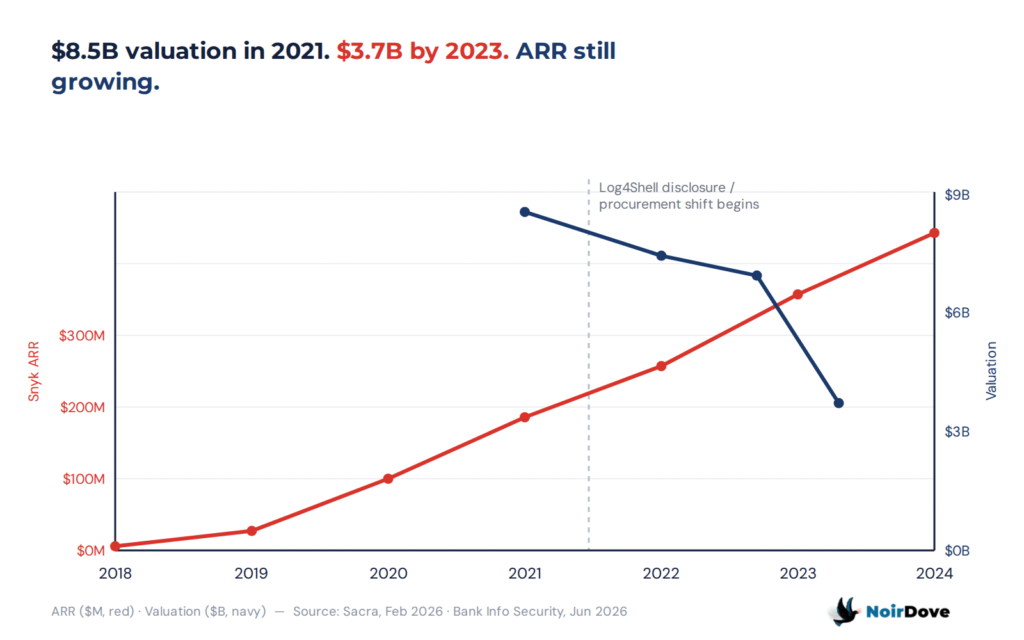
The most dangerous assumption in developer security GTM is that the market that built Snyk still exists.Snyk drove ARR from $4M in 2018 to over $300M by 2024 through a pure bottom-up motion, securing developer adoption well ahead of CISO procurement (Sacra, February 2026). That motion worked because developers had credit card budgets, organizational latitude, and no procurement gate between them and a useful tool. By December 2022, that condition had been systematically removed from most enterprises. BlackRock marked Snyk down from $8.5 billion to $3.7 billion by mid-2023 as revenue growth cooled from 50% to 12% (Bank Info Security, June 2026). The product did not change. The buyer’s organizational context did.
Summary
- Snyk built a $300M ARR machine by letting developers scan code without asking CISOs for permission (Sacra, February 2026). Fast-forward to mid-2025: revenue growth has crawled to 12%, losses sit at $166.5M, and BlackRock shaved billions off its valuation (Bank Info Security, June 2026). Gartner expects 75% of tech adoption to stay outside IT’s line of sight by 2027, but the enterprise reality is already changing and the era of frictionless developer spending is officially over.
- Gartner forecasts 75% of employees will acquire or create technology outside IT visibility by 2027, up from 41% in 2022. The organizational response to that trend has been centralized procurement, not tolerance. Security teams now sit at the approval gate for developer tooling in most enterprises (Gartner, via Adaptive Security, 2025).
- A developer security startup that launches today is selling into a two-buyer structure from day one: the developer who evaluates workflow fit, and the CISO who controls the purchase order. The 2018 Snyk motion assumed one buyer. The current market has two, and the second one did not exist at commercial scale when Snyk built its first $100 million.
TLDR
Snyk’s developer-first model relied on a 2016–2021 reality: engineers adopting software without asking permission. SolarWinds and Log4Shell shattered that dynamic. By exposing deep vulnerabilities in build pipelines and open-source packages, these two events forced security teams to centralize procurement and put an end to unchecked developer adoption. Security teams responded by pulling developer tooling into centralized procurement. The window closed on the pure developer-first motion. The market for developer security expanded. A startup that does not understand the difference between those two statements will build a go-to-market that reaches the developer, fails at procurement, and cannot explain the conversion gap.
When Snyk Signed Its First Enterprise Customer in March 2017
Guy Podjarny, Assaf Hefetz, and Danny Grander started Snyk in October 2015 with a focused utility: a free CLI tool built to catch Node.js vulnerabilities inside GitHub repositories.
It required zero security team oversight. Engineers installed it like any other dev tool, viewing open-source vulnerabilities and fixing recommendations on the spot.
It took until March 2017 to sign the first paying contract. By then, roughly 50,000 developers were using the free product (Unusual Ventures, February 2026).
That initial 50,000 to 1 ratio highlights both the magic and the flaw of early product led growth. Snyk took off in dev circles simply because it was useful and cost nothing to try, building a massive user base long before a single enterprise check was written. Adoption drove conversion, never the other way around.
The financial ramp was steep: $4 million ARR in 2018 grew to $19 million in 2019, eventually nearing $100 million ARR by 2021.
That same year, a $530 million Series F pushed Snyk’s valuation to $8.5 billion across 2.5 million users.
Those numbers were the product of a specific era in enterprise IT (2016–2021). Back then, engineers routinely paid for low-tier SaaS on company cards, ran freemium tools without procurement review, and built deep workflows long before security ever ran a vendor risk check. That organizational freedom was Snyk’s actual distribution channel.
The product was great, but the frictionless environment was the unfair advantage.
SolarWinds and Log4Shell Closed the Gate That Snyk Built Its Motion Through
On December 13, 2020, FireEye revealed that attackers had breached SolarWinds’ Orion update pipeline, using it to push malicious code to nearly 18,000 organizations. The blast radius included critical infrastructure and federal agencies like the US Treasury and the National Nuclear Security Administration.
The attack vector was a software build pipeline. A developer tool used to assemble and distribute production software had been the entry point.
Eleven months later, on December 9, 2021, a vulnerability in Apache Log4j, an open-source Java logging library used in an estimated 3 billion devices worldwide, was publicly disclosed. Any organization running Java-based software, which covered most of the enterprise market, required emergency response.
The vulnerable dependency had arrived through exactly the kind of open-source package management that Snyk was built to scan.
Both incidents shared the same attack surface: the software development process, specifically the open-source dependencies that developers adopted without formal security review. Security teams drew the obvious conclusion. The procurement autonomy that had allowed developers to adopt tools like Snyk without security oversight was the organizational condition that had allowed those vulnerabilities to accumulate without detection.
Centralized developer tool procurement followed. Organizations that had allowed engineering teams to adopt SCA, SAST, and dependency scanning tools without formal review moved those decisions into security procurement.
By 2025, 69% of organizations had formalized developer tool procurement policies requiring security team sign-off before adoption (Gartner, via Adaptive Security, 2025). The developer who had adopted Snyk in 2019 by entering a credit card now needed a purchase order, a vendor security assessment, and a CISO approval.
The Valuation Compression Lagged the Market Shift by 18 Months
Snyk’s $8.5 billion peak valuation arrived in September 2021, two months before Log4Shell. The timing suggests the market had not yet priced the procurement shift into developer security valuations. By the time the implications of software supply chain incidents became procurement policy, the bull market for developer tools had already closed.
The compression was not gradual. BlackRock marked Snyk to $3.7 billion by mid-2023, less than two years after the peak. T. Rowe Price marked it to $6.9 billion in the same period. A private equity firm that considered acquiring Snyk in 2024 proposed a price below $3 billion, which Snyk rejected (Bank Info Security, June 2026). Revenue in 2022 was $147 million. Losses were $267 million. The PLG investment had been significant.
Revenue growth recovered: $220 million in 2023 (50% growth), $278 million in 2024 (26.5% growth), then approximately 12% growth in the first half of 2025. The installed base of 4,500 customers at the end of 2024 renewed and expanded. Snyk Code, the AI-native SAST product, passed $100 million ARR in October 2024 growing 150% year over year, confirming the product continued to win on merit.
The deceleration was in net new ARR, not in existing account expansion. That gap identifies the problem precisely. The developer adoption motion was no longer converting at the rate it had in 2018 and 2019 because the conversion path had changed. Developers were still finding the product and using it. The procurement gate had moved between adoption and commercial conversion.
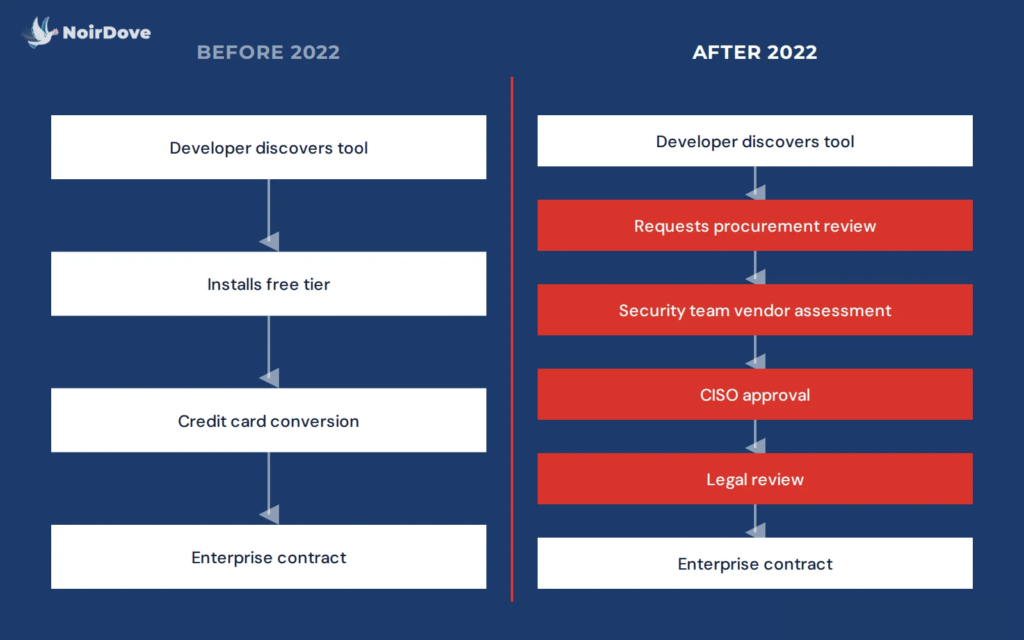
What the Current Market Actually Looks Like for a Developer Security Startup
A developer security company launching today inherits none of Snyk’s early organizational conditions and all of Snyk’s competitive context. CrowdStrike, Palo Alto Networks, and Microsoft are all now in the developer security space. Checkmarx, Veracode, and Synopsys have spent the same period that Snyk was scaling their developer experience interfaces.
Selling today means running two evaluations at once. The developer checks daily usability: seamless CLI integration, non-disruptive IDE surfacing, and low-noise CI/CD results. The CISO checks enterprise protection: supply chain risk reduction, SOC 2/ISO 27001 compliance tracking, and security oversight across production builds. Pitching just one side guarantees a stalled pipeline.
Snyk’s 2018 motion assumed one buyer and one decision. The current market has two buyers with different evaluation criteria who both have to say yes. A startup that reaches the developer and fails to engage the CISO stalls at procurement. A startup that leads with a CISO-first narrative and builds no developer adoption has no proof of value to present when the procurement evaluation runs. The motion needs both, running in parallel, from the first commercial conversation.
The uncomfortable implication: the cost structure of a two-sided go-to-market from day one is significantly higher than the PLG motion Snyk used to reach $100 million ARR. The developer-first motion was cheap to scale because free adoption required no sales involvement. A motion that simultaneously pursues developer adoption and CISO engagement requires two commercial capabilities, two sets of buyer conversations, and two narratives that must be consistent without being identical.
FAQs
Snyk hit $326 million ARR by early 2026 and Snyk Code is growing 150% year over year. If the window closed, how is the company still growing?
The installed base drives the growth. Snyk’s 4,500 customers at the end of 2024, accumulated across a decade of developer adoption, renewed and expanded through upsell into Snyk Code, container security, and IaC scanning. That installed base has an internal developer champion network that no new entrant can replicate from launch. The ARR expansion from existing accounts is structurally different from net new ARR growth from new commercial relationships. The former is driven by product quality and net revenue retention. The latter is what reveals whether the commercial motion is working in the current procurement environment. Snyk’s revenue growth deceleration from 50% to 12% reflects what new business acquisition looks like when the developer-first entry point requires a CISO approval gate.
Snyk already adapted with an enterprise sales motion alongside PLG. Would that combination work for a startup launching today?
Running both in parallel works, and it is likely the only viable structure for a developer security company now. The cost question is what makes it difficult for a startup. Snyk ran its PLG motion at scale for six years before the enterprise sales motion reached meaningful contribution. The free user base provided validation, reference accounts, and internal champions that compressed the enterprise sales cycle. A startup launching today cannot replicate the six-year PLG runway before adding the enterprise motion. They have to run both earlier, with less installed base validation, against Snyk’s existing 4,500-customer reference network. That is a harder commercial problem than the one Snyk solved between 2015 and 2021.
Is there a developer security category that still has the procurement autonomy Snyk had in 2018?
AI code generation security is the closest current analogue. GitHub Copilot was released in June 2022, and the security implications of AI-generated code, which introduces vulnerabilities at a rate that a 2023 Stanford study estimated across 40% of suggestions, are still being formalized into procurement policy. Security teams know this is a problem. Governance frameworks around AI-generated code remain fluid. For a startup offering a developer-native security tool inside the CI/CD pipeline, this creates an environment nearly identical to Snyk’s 2018 landscape, a rare, temporary window before security teams lock down procurement. The window is open because the procurement gate has not yet been formalized. It will close when the first major software supply chain incident involves an AI-generated vulnerability rather than an open-source dependency.
What is the one metric that would tell a developer security startup founder whether their commercial motion is working?
Time from free-to-paid conversion, segmented by whether the conversion was self-serve or required a CISO approval. In the 2018 Snyk motion, self-serve conversion dominated. In the current market, most enterprise conversions require CISO involvement, which extends the conversion timeline by weeks to months. A startup whose self-serve conversion rate is strong but whose time-to-conversion is extending quarter over quarter has a procurement gate problem. The developer is sold. The security team has not been engaged. That gap identifies exactly where the commercial motion needs to be rebuilt, and it shows up in conversion timing before it shows up in revenue.
Sources Referenced
- Sacra, Snyk Revenue and ARR Analysis, February 2026 (ARR $4M 2018, $19M 2019, $326M ARR February 2026; hypergrowth description; 4,500 customers end 2024)
- Bank Info Security, Snyk Finds Itself at Crossroads, June 2026 (valuation $8.5B to $3.7B; revenue $147M 2022, $220M 2023, $278M 2024; growth deceleration to 12% mid-2025; losses $267M on $147M revenue 2022)
- Unusual Ventures, How Snyk Created a Developer-First Security Company, February 2026 (50,000 registered users before first commercial contract March 2017)
- Business Model Canvas Template, Snyk Brief History, March 2026 (2.5 million developers by end of 2023; ARR trajectory)
- Komo.ai, Snyk Company Profile, 2026 (Snyk Code $100M ARR October 2024, 150% YoY growth)
- ProductGrowth.in, Snyk Review and Pricing, May 2026 (revenue trajectory; BlackRock valuation mark $3.7B mid-2023)
- Gartner, via Adaptive Security, Shadow IT and Procurement Research, 2025 (41% employees using technology outside IT visibility 2022; 75% forecast by 2027; 69% organizations formalized developer tool procurement policies)
- Stanford University, GitHub Copilot Security Study, 2023 (40% of AI code suggestions introduced vulnerabilities)
- FireEye / SolarWinds incident disclosure, December 2020 (18,000 organizations compromised via software build pipeline)
- Apache Log4j vulnerability disclosure, December 2021 (estimated 3 billion devices affected)
Talk to Noir Dove
Your developer says yes. Your CISO controls the purchase order. That gap is where most developer security pipeline stalls, and it is identifiable before it costs you a sales cycle. Noir Dove examines where in the commercial system the break is occurring. Book a Clarity Call. One conversation before you set the motion.