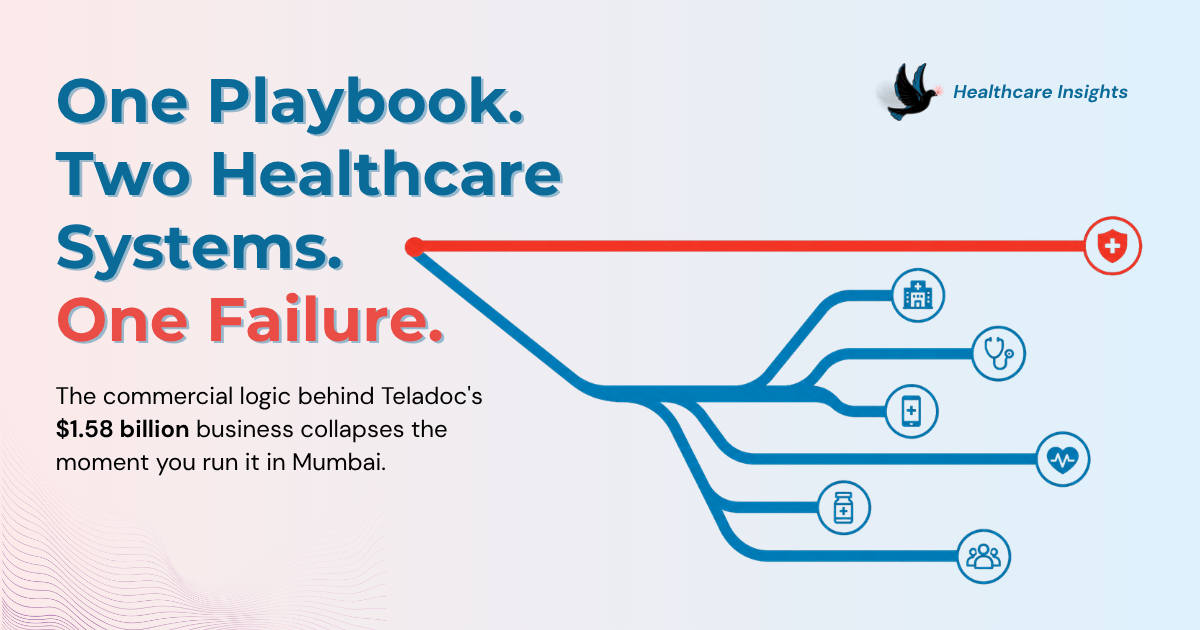
Founders building telemedicine platforms often assume a GTM model that works in one market can be adapted with minor tweaks for another. Teladoc’s employer-pay model looks like a template worth copying. It isn’t. The buyer, the regulatory scaffolding, and the payment infrastructure behind it don’t exist in India in the same form, and founders who copy the structure anyway end up selling to a buyer who isn’t there.
Summary
- Teladoc built 83% of its 2025 revenue on access fees, paid by employers and insurers on a per-member-per-month basis. That structure only exists because CMS reimbursement policy makes it billable.
- eSanjeevani, India’s government-run telemedicine platform, logged roughly 37.2 crore (372 million) consultations by mid-2025. It’s free at the point of use, and it has no private-sector equivalent at that scale.
- India’s most recent official National Health Accounts release (September 2024, covering FY 2021-22) puts out-of-pocket spending at 39.4% of total health expenditure. Roughly 40 crore Indians, about 30% of the population, still sit outside any insurance scheme, per NITI Aayog’s December 2025 restatement.
- The two GTM failure points aren’t culture or price sensitivity. They’re the buyer who pays, and the regulatory scaffolding that makes recurring billing possible.
TL;DR
US telemedicine GTM runs on employer and insurer-paid subscriptions, made possible by CMS reimbursement rules and CPT billing codes. India has no equivalent payer infrastructure at that scale. Its largest telemedicine channel, eSanjeevani, is free and government-run, and roughly 40 crore Indians remain uninsured with 39.4% of health spending still out-of-pocket (NHA, September 2024). A founder porting a PMPM, employer-sold GTM model into India is selling to a buyer that mostly doesn’t exist. Working India models instead monetize through pharmacy and diagnostics attach (Tata 1mg, Apollo 24|7), price for a narrow insured urban segment, or build alongside public infrastructure rather than against it.
Teladoc’s Business Model Only Works Because of a Regulatory Precondition That Doesn’t Exist in India
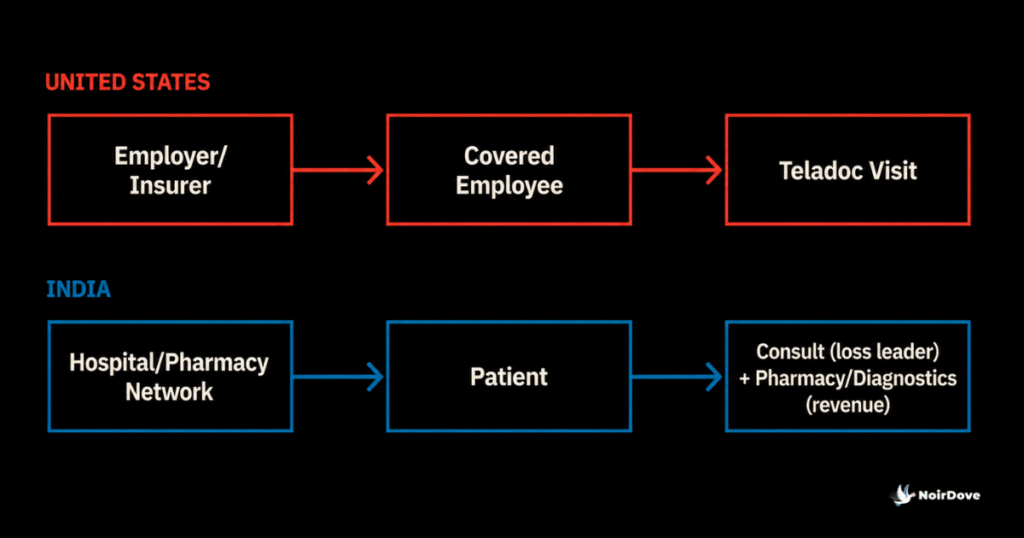
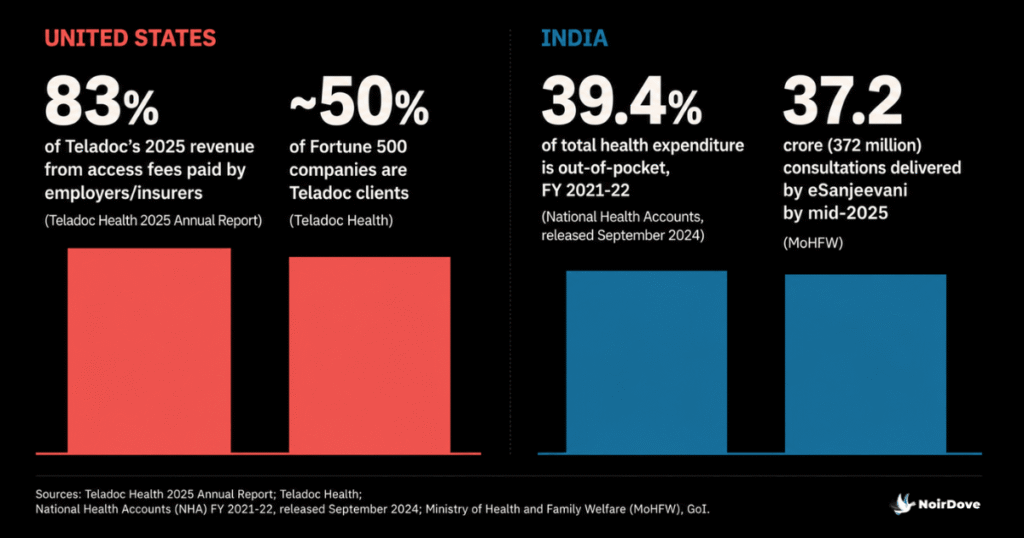
Teladoc’s Integrated Care segment generated $1.58 billion in 2025, 62% of the company’s total revenue. Of that, 83% came from access fees, the recurring per-member-per-month or per-employee-per-month charge employers and insurers pay whether or not an employee ever opens the app. Teladoc’s client base includes roughly half the Fortune 500, per the company’s own investor materials. Its real product is the covered benefit line item that HR and benefits teams buy once a year and forget about until renewal, not the consultation itself.
That model exists because US federal policy made it billable. The Consolidated Appropriations Act, 2026, signed February 3, extended Medicare telehealth flexibilities through December 31, 2027. CMS assigned a facility fee of $31.85 per encounter for 2026. There’s a dedicated CPT code family for telehealth evaluation and management visits, and a floor under geographic pricing so rural providers get paid at parity with urban ones. This is the plumbing that lets a telehealth company build a subscription business on top of insurance infrastructure, instead of chasing cash payments one visit at a time.
That plumbing is also fragile. During the 2025 government shutdown, Medicare telehealth coverage lapsed for 43 days. Providers stopped getting paid for services they’d already delivered. That single data point shows how load-bearing reimbursement policy is to the entire US telemedicine commercial model. Pull it out, even temporarily, and revenue stops.
A founder who has built GTM motion around this reality, sell to benefits teams, price per covered life, defend the renewal, walks into India and looks for the equivalent buyer. There isn’t one.
India’s Largest Telemedicine Platform Isn’t a Company. It’s a Free Government Service.
eSanjeevani is the wrong comparison point for a private telemedicine GTM strategy, and also the fact you can’t ignore. Built on a hub-and-spoke model connecting roughly 155,000 health and wellness centres to specialists in cities, it had completed about 37.2 crore (372 million) remote consultations with over 2.2 lakh (220,000) providers by mid-2025. It’s free at the point of use. It launched off the 2020 Telemedicine Practice Guidelines, formalized during the pandemic surge in teleconsultation demand.
This changes the commercial math for anyone selling telemedicine in India. In the US, a founder builds a narrow product, proves clinical and cost outcomes, and sells the outcome to a self-insured employer or a health plan. In India, eSanjeevani isn’t a competitor to displace. It’s a public service whose scale, 372 million cumulative consultations, has no private-sector equivalent, and it sets the price expectation at zero for a huge share of the population, particularly outside major metros.
Private telemedicine still works in India, just not on Teladoc’s model. Tata 1mg bundles a free or low-cost doctor consultation with online pharmacy orders and lab tests, and makes its margin on the pharmacy and diagnostics side. Apollo 24|7 runs the same logic across its hospital network: the consult is the entry point, pharmacy and diagnostics are the revenue. Founders who try to charge for the consultation itself, the way Teladoc does, generally find the willingness to pay for that specific line item is close to nothing.
The Buyer Who Pays Doesn’t Exist in India the Way It Does in the US
India’s most recent official National Health Accounts release, published September 2024 and covering FY 2021-22, puts out-of-pocket spending at 39.4% of total health expenditure. That’s down from 64.2% in 2013-14, but it’s still the single largest financing source in the system. NITI Aayog’s most recent restatement, from December 2025, puts roughly 40 crore Indians, about 30% of the population, in what it calls the “missing middle.” Too well-off for Ayushman Bharat’s hospitalization cover, unable to afford private insurance premiums. Ayushman Bharat (PM-JAY) itself has expanded hospital coverage to roughly 12.37 crore families as of June 2025, but that’s a hospitalization benefit administered by the government, not an employer-sponsored outpatient telehealth line item, and it doesn’t map to Teladoc’s PMPM model.
Compare that to the US, where the employer is the primary purchasing entity for a huge share of the working population, and where CMS reimbursement rules extend that logic into Medicare. The US telemedicine GTM motion is fundamentally a B2B2C sale. Convince a benefits director or a health plan procurement team, and the covered population follows automatically. In India, the equivalent buyer, a large employer or insurer willing to pay a recurring per-employee fee for telehealth access, exists only in the organized, white-collar, urban workforce. That’s a real market. It’s also a fraction of the size a founder modeling India off US TAM assumptions will have built into their forecast.
eSanjeevani’s usage numbers already prove Indian patients use telemedicine. The failure sits somewhere else. Founders price and structure the GTM motion for a buyer, the benefits-conscious employer paying PMPM, that represents a much smaller and more contested segment of the market than the US analog suggests.
What a Working India GTM Motion Actually Looks Like
The founders who’ve built durable telemedicine commercial models in India generally did one of three things, and none of them resemble Teladoc’s access-fee playbook.
They anchored to a hospital or pharmacy network and monetized the attach, not the consultation, the way Tata 1mg and Apollo 24|7 do. They built for a narrow, well-insured urban segment and priced accordingly, accepting a smaller TAM in exchange for a buyer who actually pays recurring fees. Or they partnered with the public infrastructure instead of competing against it, positioning themselves as the specialist referral layer on top of eSanjeevani’s primary triage.
None of these are copy-paste versions of a US GTM deck. They require rebuilding the positioning, the buyer definition, and the pricing model from the ground up, starting with a diagnosis of who actually pays for healthcare in the market you’re entering, not an assumption carried over from the market you already know.
Frequently Asked Questions (FAQs)
Does India’s Telemedicine Practice Guidelines, 2020 create the same billing infrastructure CMS created in the US?
No. The 2020 guidelines legalized teleconsultation and set clinical and prescribing rules for doctors, but they didn’t create a reimbursement code system, a payer mandate, or a parity requirement the way CMS’s Physician Fee Schedule does. A US telehealth company gets paid because a CPT code exists and a payer is obligated to honor it. An Indian telemedicine company gets paid because a patient, a hospital, or a pharmacy decides to pay it directly. That’s a commercial relationship, not a regulatory entitlement, and it changes how a sales team should be built and measured.
If eSanjeevani is free, why would any private telemedicine company survive in India at all?
Because free and comprehensive aren’t the same thing. eSanjeevani is strong at primary triage and rural access through its hub-and-spoke model, but it isn’t built for specialist continuity, chronic disease management for urban professionals, or the kind of concierge experience an employer wants to offer as a retention benefit. The opportunity isn’t replacing eSanjeevani. It’s building what it structurally can’t, in the narrower, better-funded segments of the market where a private buyer exists.
Is the US employer-pay model becoming less reliable, given Teladoc’s declining stock and revenue in 2025?
Teladoc’s Q2 2025 revenue fell 2% year-over-year to $632 million, driven mostly by BetterHelp subscriber losses, not the Integrated Care segment, which stayed comparatively stable. The employer-pay B2B model isn’t breaking. What’s shifting is the assumption that access fees alone, paid regardless of usage, will keep growing indefinitely. Teladoc’s own move toward visit-based fees for more than half of US virtual care revenue signals payers pushing back on paying for coverage nobody uses. That’s a pricing correction inside a working model, not evidence the model itself has failed.
Could a founder build one GTM motion that works in both markets simultaneously?
Only at the layer of clinical protocol and technology stack, not commercial strategy. The product architecture, video infrastructure, EMR integration, provider credentialing tooling, can be shared. The buyer, the pricing unit, the sales motion, and the regulatory dependency cannot. Founders who try to run one commercial playbook across both markets usually end up with a sales team in India pitching a PMPM model to buyers who don’t exist at that price point, while the India-specific opportunity, pharmacy and diagnostics attach, goes unbuilt because nobody on the team is measured against it.
Sources Referenced
- Teladoc Health, 2025 Annual Report
- Teladoc Health Q2 2025 earnings results
- Consolidated Appropriations Act, 2026 (H.R. 7148)
- CMS Telehealth Billing Guidelines, 2026
- Ministry of Health and Family Welfare, Government of India, eSanjeevani platform data (mid-2025)
- National Health Accounts Estimates for India 2020-21 and 2021-22, National Health Systems Resource Centre, released September 2024
- NITI Aayog, remarks on “Health Insurance for India’s Missing Middle,” December 2025
- Ayushman Bharat PM-JAY enrollment data, as of June 2025
- Telemedicine Practice Guidelines, 2020, Government of India
Talk to Noir Dove
If your telemedicine GTM was built for one market and you’re expanding into another, the playbook doesn’t travel with the product. Noir Dove diagnoses where your commercial system breaks before you spend on a second market’s execution.