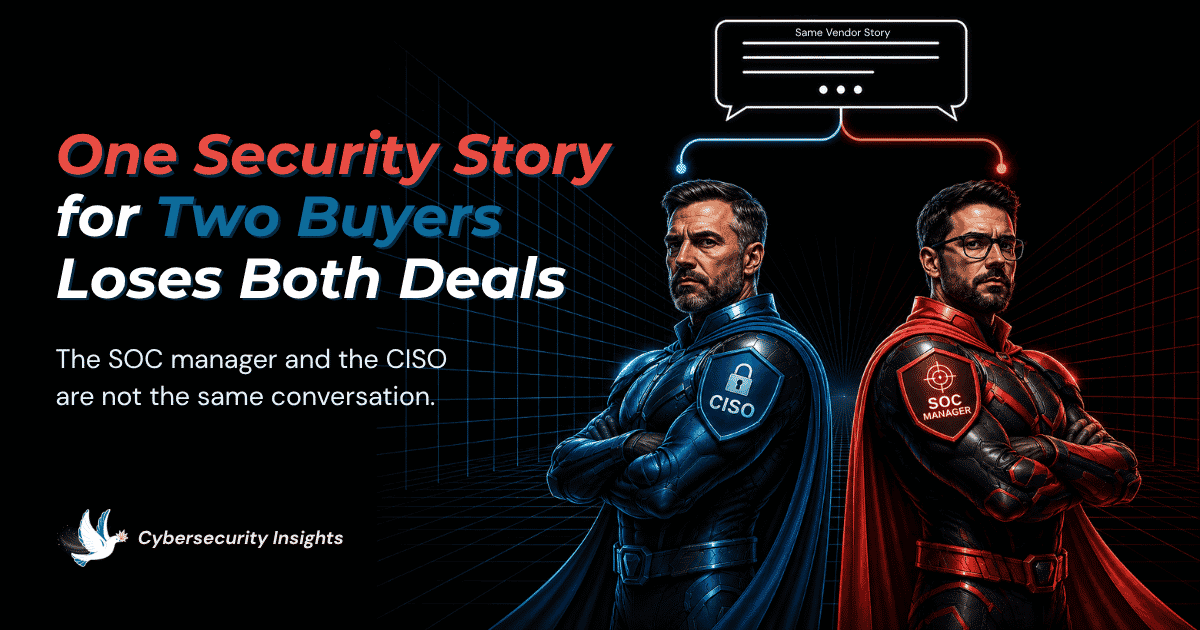
Security startups consistently lose deals they should not lose because they walk into a dual-buyer situation with a single story. The SOC manager running the technical evaluation is drowning: the average organization receives thousands of security alerts per day, and roughly two-thirds are false positives (Wiz Research, June 2026). The SANS 2025 SOC Survey found 70% of SOC analysts with five years or less experience leave within three years. Meanwhile, the CISO who controls budget approval is focused on an entirely different problem: 76% of CISOs report being overwhelmed by tools, and 6 in 10 have made vendor consolidation their top priority (Gigamon, 2024). Pitching investigation speed to a CISO sounds like more sprawl. Pitching risk reduction to a SOC manager sounds like the pitch they heard from the last four vendors. Both stories fail because they were written for the wrong person.
Key Takeaways
- 76% of SOC teams cite alert fatigue as their top operational challenge, and 73% report analyst burnout as a direct consequence — the SOC manager’s primary concern is operational survival, not strategic risk (Cybersecurity Insiders, 2025).
- 6 in 10 CISOs list tool consolidation and optimization as their number one priority, making a new vendor pitch the exact opposite of what they want to hear before they have seen proof (Gigamon CISO Survey, 2024).
- 82% of CISOs now report directly to the CEO, up from 47% in 2023, which means the board conversation is no longer optional — CISOs are translating every security decision into business risk language (Help Net Security, December 2025).
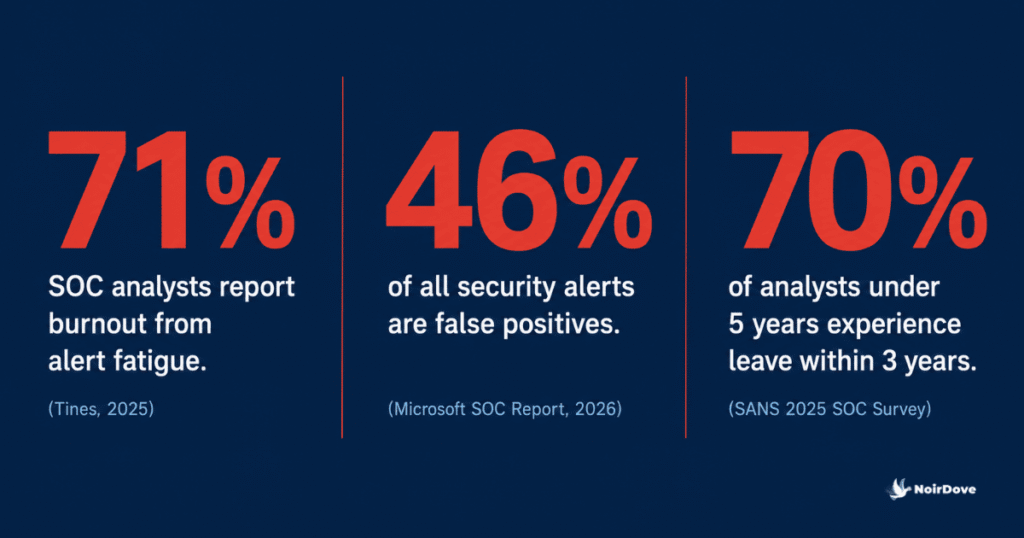
- 70% of SOC analysts with five years or less experience leave within three years, which means analyst retention is a revenue problem for the SOC manager, not just an HR one (SANS 2025 SOC Survey).
Pitching the same story to both buyers? Book a Clarity Call and we will start by separating what each buyer actually needs to hear.
TL;DR
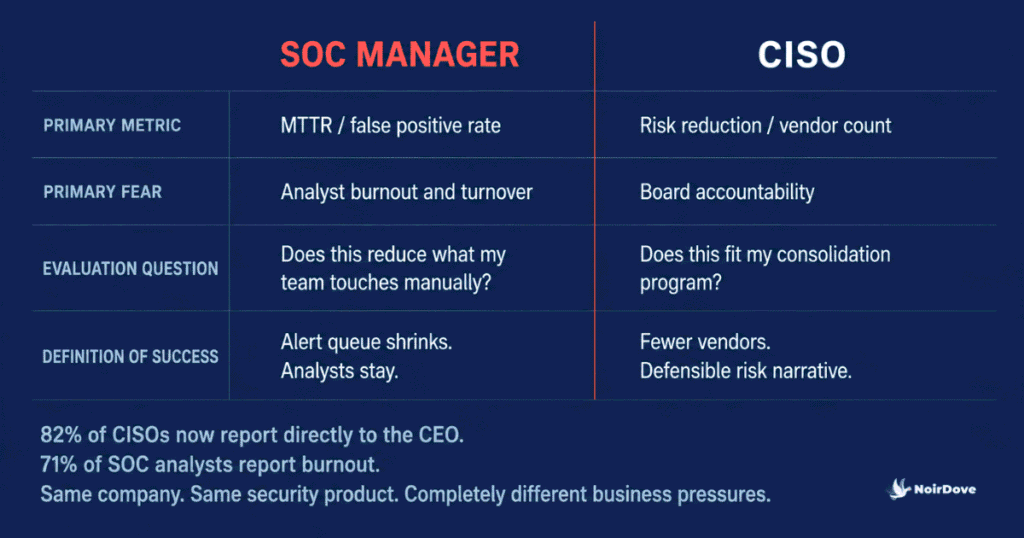
The SOC manager and the CISO evaluate on opposite criteria. The SOC manager is measured on alert volume, false positive rate, and analyst retention. The CISO is measured on risk reduction, vendor count, and board defensibility. A pitch built for one fails the other at a different stage of the same deal. The fix is not a better pitch. It is two separate narratives, sequenced correctly: SOC proof first, CISO business case second.
Security startups lose deals they should not lose because they carry a single story into a dual-buyer structure.
The SOC manager running the technical evaluation is managing alert volume. Two-thirds of alerts per day are false positives (Wiz Research, June 2026). 70% of analysts under five years leave within three years (SANS 2025). Their problem is operational survival.
The CISO controlling budget approval is managing vendor relationships and board exposure. 76% report being overwhelmed by tool sprawl (Gigamon, 2024). Their problem is strategic risk and political credibility.
Pitching investigation speed to a CISO registers as more sprawl.
Pitching risk reduction to a SOC manager sounds like the last four vendors.
Both fail because they were written for the wrong person.
The SOC Manager and the CISO Are Running Two Completely Different Jobs
The SOC manager is an operational leader.
Measured on: mean time to detect, mean time to respond, false positive rate, analyst retention.
46% of all alerts are false positives — nearly half of a SOC analyst’s daily workload produces no security value (Microsoft SOC Report, 2026). 75% of analysts no longer have time for threat hunting.
The CISO is running a governance function.
Measured on: risk reduction, regulatory compliance posture, vendor contract discipline, board reporting.
82% of CISOs report directly to the CEO, up from 47% in 2023. 83% participate in board meetings regularly (Help Net Security, December 2025).
The board conversation is not about alert volume. It is about whether the security investment is producing defensible risk reduction.
A pitch that leads with MTTR addresses the SOC manager’s problem directly. That same pitch lands in the CISO’s board prep as “new vendor reduces MTTR” — which does not translate. Security startups that send one pitch to both are not being efficient. They are misreading the buying structure.
Alert Fatigue Is a Retention and Budget Problem, Not a Workflow Problem
71% of SOC analysts report burnout from alert fatigue. Some SOCs are seeing turnover cycles under 18 months (Tines, 2025).
When an analyst leaves, detection knowledge leaves with them. The next hire starts the learning curve while the existing team absorbs the load.
79% of 24/7 SOC operations experience peak fatigue during shift transitions, when active context is lost between teams (SANS 2025). Each handoff creates a detection gap.
The SOC manager’s evaluation question is not “does this improve our risk posture?”
It is: does this reduce what my analysts have to touch manually?
35% of analysts say manual repetitive triage has directly increased their burnout (Microsoft SOC Report, 2026).
The chain is direct: manual triage drives burnout, burnout drives turnover, turnover weakens detection.
That chain is what the SOC narrative needs to break. Not in theory. With a measurable POC result: false positives reduced by X%, investigation time down by Y minutes per alert, analyst hours freed per week.
The CISO Hears “New Vendor” and Runs a Consolidation Calculation
40% of organizations are already mid-consolidation. 21% are planning it (Fortra, 2025).
A startup arriving with a new product category is walking into a conversation the CISO did not want to have.
The Gartner 2025 CISO Leadership Perspectives Survey found reducing risk ranked fifth among enterprise priorities — despite ranking first within the security function. The CISO is being measured by the business on criteria the security team does not control.
Board-level criteria: organizational resilience, regulatory compliance, third-party risk visibility.
The CISO is not asking “does this detect faster?”
They are asking: does this reduce what I have to explain to the board, and does it fit within the consolidation program I am already running?
A startup that cannot answer the second question in the first meeting rarely gets a second meeting.
The SOC manager escalates. The CISO kills it at budget. The loss is logged as “timing” or “budget constraints.” The actual cause is never identified.
If your pipeline stalls after the technical evaluation, the gap is usually in the CISO story, not the product. Check our cybersecurity solution to see how we examine this.
The Evaluation Criteria Are Not Just Different. They Conflict.
A comprehensive narrative attempts to cover both buyers. It ends up specific enough for neither.
SOC manager evaluation criteria: False positive reduction. Investigation time. Analyst workload. Shift handoff quality. SIEM and SOAR integration depth.
46% of security teams spend more time maintaining tools than defending the organization (Splunk, May 2025). The SOC manager is asking whether a new product adds to that burden or reduces it.
CISO evaluation criteria: Quantifiable risk reduction. Compliance coverage. Vendor contract structure. Fit within the consolidation program.
83% of CISOs participate in board meetings regularly (Help Net Security, December 2025). Every product in the stack has to be defensible in that room.
The criteria conflict directly:
The SOC manager wants more integrations for operational context. The CISO wants fewer vendors to justify.
The SOC manager wants a fast POC. The CISO wants a deliberate procurement process with no new contractual exposure.
One narrative cannot resolve both. Attempting to compress them produces a pitch that advances through technical evaluation and stalls at budget approval. Consistently. Quarter after quarter.
The Dual Narrative Framework: One Product, Two Entry Points, One Sequence
SOC manager narrative — lead with operational proof.
The claim must be measurable within 30 days:
- False positive rate reduced by X%
- Investigation time down by Y minutes per alert
- Analyst hours freed from manual triage per week
Burned-out analysts take longer to investigate, miss detections, and leave with the institutional knowledge that trained them (Wiz Research, June 2026). The SOC narrative positions the product as the fix to that specific operational cycle.
CISO narrative — lead with risk reduction in board language.
Not MTTR. Not false positive rate. Those are inputs.
The output the CISO needs: breach probability decreased, regulatory exposure reduced in a named compliance area, vendor count reduced while detection coverage held.
Security Operations moved into the top five CISO priorities in 2025 (Gartner CISO Leadership Perspectives, 2025). The CISO narrative connects the product’s operational result to the risk story they are already building for the board.
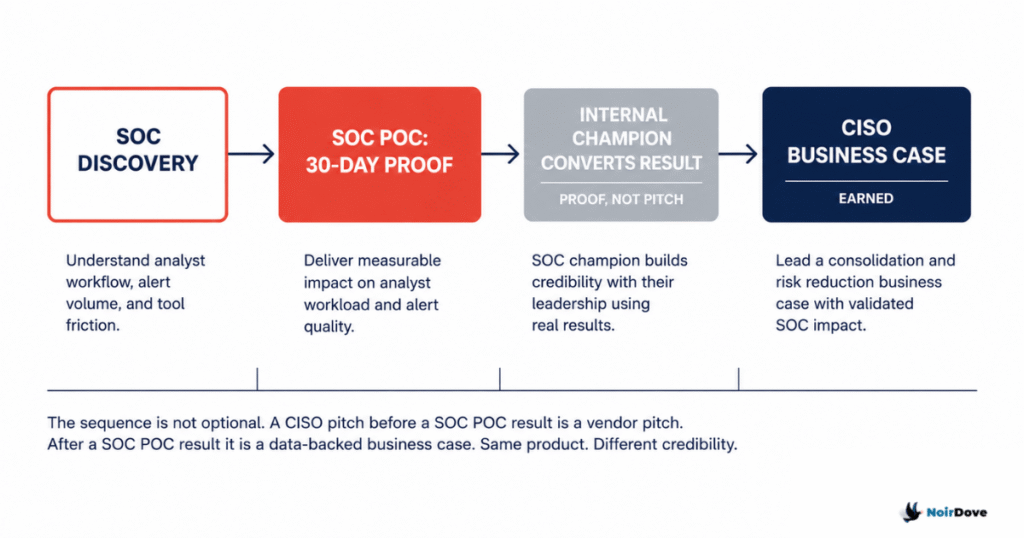
The sequencing is not optional.
SOC proof comes first. A 30-day POC with a measurable result gives the SOC manager something to present internally. That internal champion conversation is more credible than any vendor pitch. The CISO receiving data from their own environment evaluates differently than the CISO receiving a sales deck.
The criteria do not just differ. In some cases they conflict. A SOC manager wants more integrations for operational context. A CISO wants fewer vendors to manage. A SOC manager wants to move fast on a POC to solve an immediate analyst retention problem. A CISO wants a deliberate procurement process that does not create new contractual exposure. Pitching the same story to both is not a minor inefficiency. It is a structural commercial problem that produces deals which advance through technical evaluation and stall at budget approval, consistently, across multiple quarters.
The Dual Narrative Framework: One Product, Two Entry Points
Building two narratives off one product is not about creating contradictory messages. It is about leading with the right problem for each buyer and sequencing the commercial motion accordingly.
The SOC manager narrative leads with operational proof. The specific claim needs to be measurable within a 30-day POC: false positive reduction by a named percentage, investigation time reduced by a specific number of minutes per alert, or analyst hours freed from manual triage per week. Burned-out analysts take longer to investigate threats, miss critical detections more frequently, and eventually leave, taking institutional knowledge with them (Wiz Research, June 2026). The SOC narrative frames the product as the solution to that specific cycle, not to security risk in the abstract.
The CISO narrative leads with risk reduction that translates to board language. Not MTTR. Not false positive rate. Those are inputs. The output the CISO needs to communicate upward is: the probability of a breach event decreased, regulatory exposure reduced in a named compliance area, or vendor count reduced while detection coverage held. Measuring and communicating risk continues to be a focus area, with Security Operations moving into the top five CISO priorities in 2025 (Gartner CISO Leadership Perspectives, 2025). The CISO narrative connects the product’s operational output to the risk narrative they are already building for the board.
The sequencing is as important as the content. SOC manager proof comes first. A 30-day POC that produces a measurable operational result gives the SOC manager something concrete to take to the CISO. That internal champion conversation is more credible than any external pitch. The CISO who receives a POC result from their own team evaluates differently than one who receives a vendor pitch. One is data from their environment. The other is a claim from a startup.
Frequently Asked Questions (FAQs)
At what point in the sales cycle should we introduce the CISO, and should they ever be in the same meeting as the SOC manager?
Introduce the CISO after the SOC manager has a result to present, not before. A joint meeting before the SOC manager has validated the product forces the startup to run both narratives simultaneously, which typically collapses into a generic pitch that satisfies neither buyer. The exception is when the CISO is also the economic buyer and the SOC manager has no budget authority — in that case, separate the conversations sequentially rather than concurrently. Run the SOC manager evaluation first, get a documented result, then use that result as the opening of the CISO conversation rather than a product pitch.
How do we handle it when the CISO is skeptical of a new vendor during the SOC manager’s evaluation?
The CISO’s skepticism at this stage is almost always about vendor count, not product quality. Address it directly with contract structure rather than product messaging: shorter initial terms, named exit clauses, and a clearly defined proof-of-value milestone that determines whether the engagement expands. Shorter contracts are less risky but usually cost more (TechTarget, 2025). Offer the CISO optionality on contract length and make the expansion conditional on a specific metric. That framing removes the lock-in objection without requiring the product to compete on the CISO’s consolidation agenda.
We sell to MSSPs who then deploy to end clients. Does the same dual narrative apply?
Yes, but the buyer split runs differently. The MSSP’s technical team is your SOC manager equivalent: they evaluate on operational criteria, integration quality, and the effort required to onboard and manage the product across a client base. The MSSP’s leadership team is your CISO equivalent: they evaluate on margin impact, client retention, and whether the product strengthens or complicates their service delivery motion. Lead with the operational story in the technical evaluation, then build the business case for leadership separately, using metrics their clients will cite at renewal conversations.
If we are already six months into a stalled deal and suspect a messaging mismatch, is there a way to recover?
The recovery depends on where the deal stalled. If it stopped after the technical POC, the SOC narrative landed but the CISO conversation never happened or happened with the wrong framing. Request a separate 30-minute session with the CISO, not as a sales call but as a findings review, and bring the POC metrics translated into risk language: what the product detected that existing tools missed, what the operational savings translate to in analyst hours, and what the compliance impact is in a named regulatory area. A Noir Dove diagnostic can identify which stage the mismatch is occurring in. Book a Clarity Call to walk through it.
Your product works. The story you are telling about it is doing the evaluation before the buyer does.
Most pipeline stalls in enterprise security deals are not product problems. They are messaging problems that surface at the wrong stage of the buying cycle. A pitch that lands with the SOC manager and dies with the CISO is almost always a framing problem, not a capability problem.
We examine the commercial system before recommending anything — the buyer journey, the narrative for each stakeholder, and the sequencing of proof that moves deals from technical evaluation to signed contract.