There are now more than 5,000 cybersecurity vendors competing for CISO attention globally (CyberDB, 2026), and the majority describe themselves as a platform. The word was supposed to signal integration depth and strategic importance. Instead, 68% of CISOs now report that aggressive vendor marketing makes it nearly impossible to distinguish genuine innovation from noise. “Platform” became the noise. This article breaks down why the word backfires at the wrong stage, what two specific objections it triggers in enterprise buyers, and the sequencing logic that lets startups convey the same ambition without the credibility cost.
Key Takeaways
- 68% of CISOs report that aggressive cybersecurity vendor marketing makes it nearly impossible to distinguish real innovation from positioning claims — platform language is a primary contributor to that signal loss (CyberDB, 2026).
- 75% of organizations are actively pursuing vendor consolidation strategies to reduce complexity (Gartner, 2024), which means enterprise buyers are looking for reasons to cut vendor relationships, not add them — platform promises read as lock-in risk, not value.
- 68% of organizations already manage more than 11 tools for endpoint management and security alone, creating the exact tool sprawl “platform” promises to solve — but CISOs have heard that promise before (Syxsense, 2023).
- Palo Alto Networks, CrowdStrike, and Wiz each earned platform language after proving point-solution value first. None of them opened with it. The sequence — specific problem, documented proof, then platform — is the pattern that holds.
If your positioning relies on “platform” before you can show a buyer three reference customers who have run the full stack, book a GTM audit before the next sales cycle starts.
TL;DR
Platform messaging in cybersecurity GTM loses deals when used before the evidence exists to back it up. With more than 5,000 vendors in the market, the word carries no differentiating information and triggers two specific buyer objections: integration complexity and vendor lock-in. The vendors that built credible platform narratives — Palo Alto Networks, CrowdStrike, Wiz — earned the language by proving a specific problem first, accumulating named integrations and reference customers, and only then using platform as a description the market could verify. Startups that reverse this sequence are not communicating ambition. They are triggering skepticism they cannot yet answer.
Palo Alto Networks cleared $5.6 billion in next-generation security ARR in FY2025 and calls itself a platform. CrowdStrike crossed $5.25 billion in ARR and calls itself a platform. Microsoft’s security revenue exceeded $20 billion and it calls itself a platform. Now a Series B startup with 40 customers calls itself a platform. The word has done exactly what overuse always does: it has stopped meaning anything. With more than 5,000 cybersecurity vendors in the market (CyberDB, 2026) and 68% of CISOs already reporting that vendor marketing makes genuine innovation indistinguishable from noise, “platform” is not positioning. It is the sound of a deal going sideways before the first meeting ends.
Platform Fatigue Is Measurable, and It Is Getting Worse
The tool sprawl problem is real. According to a 2023 Syxsense survey, 68% of organizations run more than 11 tools for endpoint management and security alone — before accounting for identity, cloud, SIEM, or network layers. That fragmentation is the genuine pain that platform messaging is supposed to address. Security teams do want fewer moving parts. They do want integration and workflow coherence.
The problem is that every vendor positioned as the solution to sprawl has contributed to it. Each new “unified platform” added another contract, another support queue, another integration to maintain. CISOs have lived through enough of these cycles that the word “platform” now reads as a warning rather than a promise. Help Net Security documented this dynamic in April 2025, noting that CISOs are increasingly battle-worn from platform promises that produced more complexity, not less.
The credibility gap widens the earlier a vendor uses the word. At Series A or B, a startup calling itself a platform has no reference customers who have run the full stack, no documented integrations buyers can verify, and no proof that the product reduces complexity rather than adding to it. The claim is not just unproven — it actively confirms the buyer’s fear that this vendor will become another sprawl contributor.
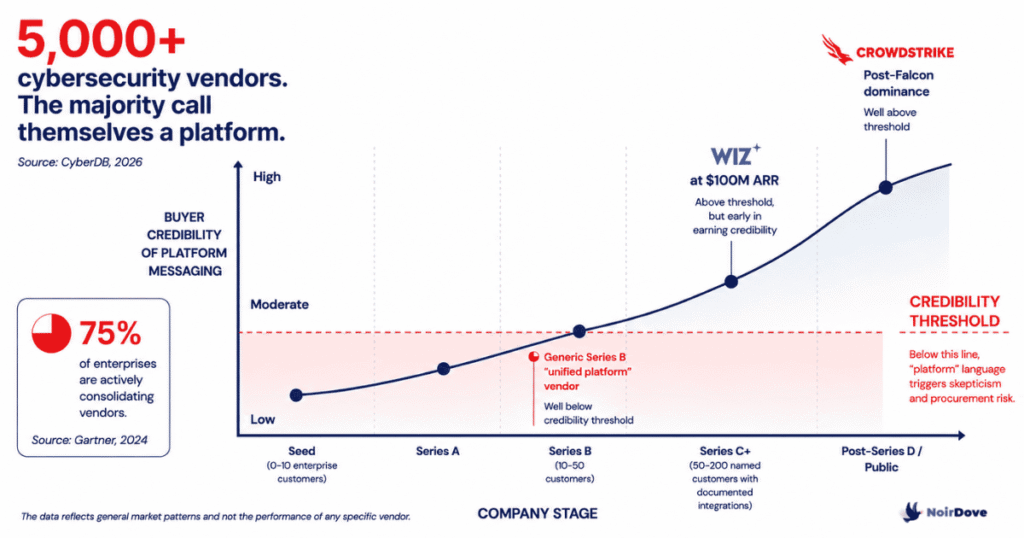
When the proof does not exist yet, the word should not appear in external materials. Specific problem statements, named outcomes, and verifiable integrations do the same positioning work without triggering the same objections.
The Two Objections “Platform” Triggers Before You Finish the Sentence
Enterprise security buyers have two learned responses to platform claims, and both come from experience rather than paranoia.
The first is integration complexity. A CISO who has deployed a “unified security platform” that turned out to be four point solutions behind a single login knows exactly what the onboarding looks like: separate connectors, separate support queues, separate update cycles, and an API that breaks on the upstream vendor’s major release. The platform promise was real in the sales deck. The production reality was eight months of integration work nobody budgeted for.
The second is vendor lock-in. Platform signals expansion by design. A vendor calling itself a platform is signaling that it intends to become more central to the security stack over time — adding modules, expanding surface area, growing the contract. That is true of every platform vendor. It is also a procurement risk for an organization that Gartner’s 2024 data shows is already mid-consolidation: 75% of organizations are actively reducing vendor count, not extending it. The buyer filtering out “platform” in an email subject line is not being irrational. They are applying a learned filter that has served them accurately before.
The startup that triggers both objections in the first meeting, without the reference customers or integration proof to answer them, does not usually get a second meeting. The loss gets logged as “budget” or “not the right time.” The actual cause was a positioning choice made before the deck was built.
Still using “platform” in your homepage headline before you have 50 named enterprise customers? Book a 45-minute GTM audit — no deck required.
How Palo Alto, CrowdStrike, and Wiz Earned the Word They Now Own
The three vendors most associated with platform credibility in cybersecurity followed the same sequence, even though none of them named it as a strategy.
Palo Alto Networks started with a specific, bounded problem: application-layer visibility in firewalls, something existing perimeter tools were not built to provide. Nir Zuk’s 2005 roadshow across 50+ enterprise accounts confirmed customers trusted their existing integrators more than new vendors. The product had to prove itself in a specific category before any platform conversation was possible. The platform story came after acquisitions of Demisto, Twistlock, and Expanse gave the claim something concrete to point to — named integrations, documented interoperability, and a customer base large enough to verify the story independently.
CrowdStrike’s pattern was identical. Falcon launched as an endpoint detection product against Symantec and McAfee. The platform expansion into identity, cloud workload, and SIEM came after Falcon was running on endpoints across a median enterprise customer base that now uses seven or more modules. The trust was built at endpoint first. The expansion leveraged that trust — it did not ask for it in advance. CrowdStrike now reports $5.25 billion in ARR and serves more than 50% of the Fortune 1000 (Programs.com, 2026). The scale of the platform claim matches the scale of the installed base that validates it.
Wiz reached $100 million ARR in 18 months by solving a specific, nameable problem: toxic combinations of cloud risk — misconfigurations, exposed identities, and unpatched vulnerabilities that individually were low severity but combined created an exploitable blast radius. The agentless architecture removed the deployment friction that had slowed competing CNAPP tools in POC evaluations. By the time Wiz used “platform” in its messaging, the security graph had been deployed across hundreds of production environments and buyers could verify the integration claim before the first conversation.
The pattern is consistent across all three: specific problem, accumulated proof, then platform language.
Three Positioning Approaches That Carry Platform Ambition Without the Cost
The goal is not to hide that the product will eventually expand. It is to sequence the evidence so the platform claim lands after the buyer can already see it is true.
Problem-first positioning names the exact failure mode the product prevents, specifically enough that a security engineer can describe it to their CISO in one sentence. “Cloud attack path visualization for multi-account AWS environments” is more credible than “cloud security platform” at Series A, because specificity implies domain depth. TechTarget research found that 59% of cybersecurity buyers rank case studies as one of their top three purchase influencers (TechTarget, 2025). A case study that describes the specific attack pattern prevented — not the product features deployed — is more persuasive than any positioning statement.
Outcome-first positioning replaces the product description with a measurable change. Abnormal Security’s early GTM was not “AI-powered email security platform.” The positioning was closer to: behavioral analysis that catches business email compromise your existing email gateway is not built to detect. The differentiation is concrete and testable in a 30-day POC. Platform claims are not testable until after full deployment. Outcome claims can be falsified in a month.
Ecosystem positioning places the product inside the buyer’s current stack rather than replacing it. A vendor that says “we surface identity risk findings inside your existing SIEM workflow” is removing both platform objections simultaneously — integration complexity (already done) and lock-in (no rip and replace). It also signals something the buyer values in a consolidation environment: the vendor understands the existing stack well enough to work inside it.
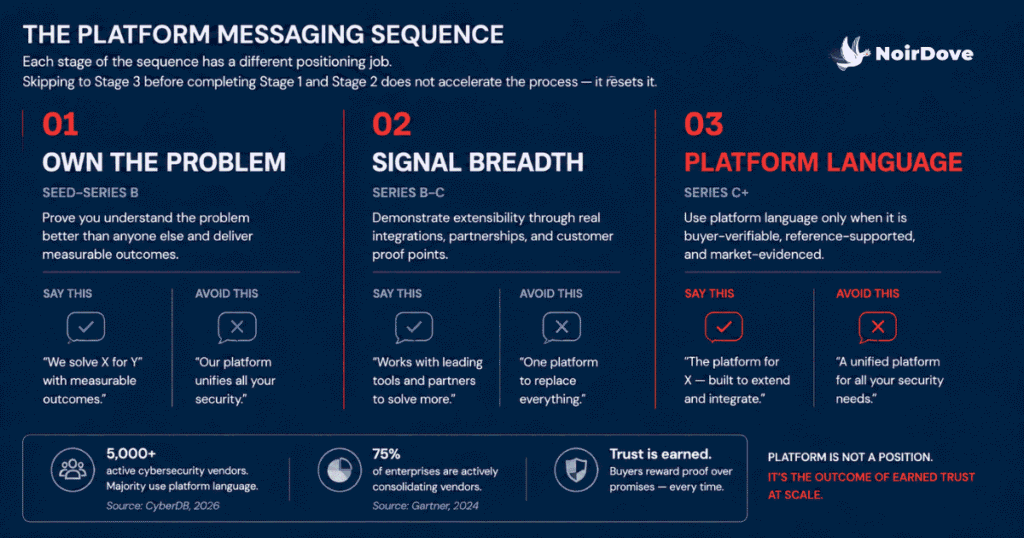
None of these approaches prevents the platform story from emerging later. They prevent it from triggering skepticism before the proof exists.
One Test Before the Word Goes in the Deck
Before “platform” appears in any external material, run one check.
Call a reference customer. Ask them to describe the product to a peer in two sentences without coaching. If they name a specific problem the product solved and a result they can quantify, the company is not a platform in the market’s perception yet — and that is fine. Lead with what the customer said. If they describe an integrated set of capabilities that replaced multiple tools and explain how the product sits at the center of their security operations workflow, the platform story is real. Use it.
The second version of that conversation is what Palo Alto Networks built toward across a decade of sales cycles and nine-figure acquisitions. The first version is what the majority of Series B cybersecurity startups are sitting with when they open a cold outreach email with “unified security platform.”
Every startup that reaches for the word before earning it makes the environment harder for the ones that genuinely get there. The CISO who stops reading at “platform” in the subject line does not re-engage six months later when the company that actually built one shows up.
That is the cost that never appears in a win/loss report.
Frequently Asked Questions (FAQs)
At what point does platform messaging become credible to enterprise buyers — is there a customer count or ARR threshold?
There is no revenue number that unlocks the word. Credibility is a function of integration depth and reference density. A company at $15M ARR with 15 documented, named integrations and 25 enterprise case studies can use platform language more credibly than one at $60M ARR with a single product and five logo case studies. The practical test: can you send a prospect to three reference customers who have run the product alongside other tools in their stack and who can describe how the workflow connects? If those conversations exist and produce consistent answers, the platform claim is defensible. If they do not, ARR does not compensate.
Does leading with a specific problem statement limit deal size or exclude the company from broader platform RFPs?
In the short term, a narrow positioning statement can get routed to a lower-level buyer or excluded from an RFP scoped for a broader category. That risk is real. The larger risk is that platform language too early gets the company dismissed before the evaluation begins. A startup excluded from an RFP because its positioning was too specific can expand the scope in a second conversation. A startup dismissed because a CISO filtered “platform” as noise does not usually get that second conversation. Expansion is easier to manage inside an active evaluation than at the positioning stage.
How did CrowdStrike expand from endpoint to identity, cloud, and SIEM without triggering the platform skepticism that affects startups?
CrowdStrike was running on every device at the median enterprise customer before it announced the expansion. When the telemetry from that deployment is already flowing and the trust is established at the category level, the conversation about adding an identity or cloud module starts from proof rather than from a pitch. Falcon’s platform expansion was announced after the endpoint product had achieved that depth of penetration — not before. The naming convention followed the installed-base reality. Startups that open with the platform name before the installed base exists reverse the sequence and pay for it in deal velocity.
If I suspect my current platform messaging is costing deals, what does a GTM audit from Noir Dove actually examine?
The Noir Dove Diagnostic looks at where in the commercial system the positioning is leaking — which could be the homepage copy, the outbound sequence, the discovery deck, or the sales team’s verbal framing in the first call. We map what buyers are actually hearing against what the evidence currently supports, identify the specific stage mismatch, and build the sequencing that closes the gap. The audit is 45 minutes, starts with the Diagnostic, and does not prescribe before we have examined the actual commercial system. Book a call at noirdove.com/cybersecurity-gtm/.
Your positioning is doing the evaluation before the buyer takes the meeting.
The word “platform” in your GTM is either an asset or a liability, depending entirely on whether the evidence exists to back it up. If you are not sure which it is, that uncertainty is costing you meetings you do not know you are losing.
We help B2B security founders audit their GTM messaging and build the sequencing that matches where they actually are in the market — not where they plan to be in 18 months.